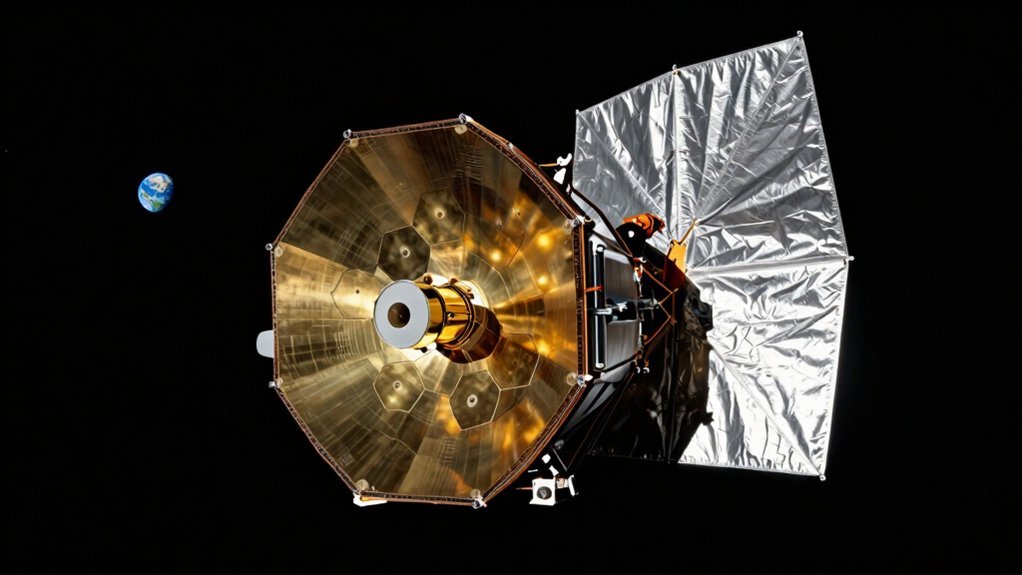
You’re confused by wildly different numbers, but right now exactly 29 active space telescopes orbit Earth. Here’s the thing: counts vary because some sources include dead missions or satellites with cameras, not just dedicated observatories. Obviously, you need clear definitions to get real facts about instruments like Hubble and Webb. Stick with the 29 active missions for accurate current data, then explore how future launches will expand this fleet soon.
How Many Active Space Telescopes Are Orbiting Now?
Ever wonder exactly how many space telescopes are watching the sky right now? You’d see about 29 active missions if you count everything from Hubble to JWST. Mission longevity keeps older giants like Chandra working while new ones join the fray.
These observatories don’t just sit in one spot; they utilize diverse orbit types. Some hug Earth in low orbits, while others park at distant Lagrange points. Obviously, this spread helps them avoid interference and see different cosmic angles.
You’re looking at a living count that shifts as launches succeed or failures occur. The number stays in the high 20s for now, but it won’t stay static. Keep this range in mind as you dig deeper into specific data sources.
While space-based instruments offer unique vantage points, understanding how to compare telescopes on Earth remains essential for selecting the right gear for your own stargazing journey. Just as orbital position affects a satellite’s view, the optics and performance of a ground-based scope determine what you can see from your backyard. Much like choosing between reflector or refractor designs on the ground, selecting a space observatory depends on the specific wavelengths it is built to detect.
Why Do Official Telescope Counts Vary So Widely?
Why do you keep seeing wildly different numbers for space telescopes? You’re confused because sources mix active, dead, and historical missions together. One list might count only twenty-six working craft, while another tallies over ninety launched since 1970. Obviously, including broken satellites changes your total considerably.
Here’s the thing: definition discrepancies drive most of this chaos. Some catalogs count only dedicated observatories, while others include any satellite with a camera. You’ll find totals shifting from mid-twenties to ninety-plus based on these loose rules. Agency classifications also split the counts markedly. If a source lists only NASA and ESA missions, you get a smaller number than broader international lists. This confusion persists even when distinguishing between major flagship missions like Webb and Roman versus smaller survey satellites. Understanding the specific optical design of each instrument helps clarify why some general survey satellites are excluded from strict observatory counts. Just as ground-based users must evaluate optics and performance to choose the right telescope, space mission lists vary based on whether they prioritize scientific capability or mere launch history. Different telescope types utilize varying light gathering capabilities, which further complicates whether a simple imaging satellite qualifies as a true scientific observatory in strict catalogs.
Now, you see why one single answer doesn’t exist yet. You must check which specific rules each author used before trusting their headline number. Next, let’s figure out what actually qualifies as a dedicated space observatory.
What Qualifies as a Dedicated Space Observatory?
Since you’re wondering what actually counts, let’s clear up that definition mess right now. You need a satellite built primarily for astronomy, not just one with incidental cameras. Its mission design must prioritize stable pointing and scientific data over communications or navigation duties.
Obviously, these observatories target wavelengths blocked by our atmosphere, like ultraviolet or X-rays. Your telescope might cover a single band or offer broad multi-wavelength coverage for deeper analysis. Engineers place them in specific orbits to guarantee thermal stability and unobstructed views. For enthusiasts tracking these missions, understanding orbital mechanics helps explain why certain locations are chosen to minimize interference and maximize observation time. Unlike ground-based units that rely on adaptive optics to correct atmospheric distortion, space telescopes operate above the turbulence entirely to achieve diffraction-limited resolution.
Here’s the thing: if the main goal isn’t studying stars or galaxies, it doesn’t qualify. You should look for platforms dedicated entirely to revealing cosmic secrets above the clouds. Now you know exactly which machines truly earn the observatory title. Ready to meet the specific giants still working out there? Crucially, experts emphasize that thermal stability is a non-negotiable engineering requirement to prevent instrument distortion and ensure the high-precision measurements needed for deep space observation.
Which Major Telescopes Are Still Operating Today?
How exactly do you separate the active giants from the retired legends? You check their operational capabilities right now. Hubble still captures optical light, while Webb dominates infrared views from L2. Chandra and XMM-Newton hunt X-rays, and Fermi tracks gamma rays daily.
Here’s the thing: different observational wavelengths need specific orbits. Hubble circles Earth, but Webb sits far away at L2 for cold stability. Missions like Euclid, TESS, and CHEOPS also keep working hard on exoplanets. Obviously, ground telescopes don’t count in this exclusive space club. Selecting the right instrument requires understanding wavelength coverage to match specific scientific goals with the appropriate observatory. For enthusiasts aiming to maximize their viewing sessions, applying essential tips can significantly improve the clarity and success of observations.
You see a diverse fleet covering every energy range imaginable. No single telescope does it all, so they work together perfectly. This active ecosystem proves space astronomy is thriving, not dying. Ready to explore how many launched since 1970? For those seeking practical insights, expert-backed guidance ensures you understand the distinct roles these observatories play in modern astronomy.
How Many Telescopes Have Launched Since 1970?
You just saw the active fleet, but counting the retired ones changes the whole picture. Since 1970, NASA and ESA have launched more than 90 space telescopes into orbit. That averages roughly two launches per year over five decades.
Reviewing launch statistics reveals 61 inactive missions alongside the 26 currently working. Mission durations vary wildly, from short-lived probes to legends like Hubble. You see a steady expansion from early experiments to today’s specialized observatories.
This total covers visible light, X-rays, and gamma-ray hunters alike. It represents a minimum benchmark rather than an exact census of every instrument. Obviously, the definition of “telescope” shifts the final count slightly. While space instruments excel above the atmosphere, selecting the right tool on Earth requires balancing optics and cost to match a stargazer’s specific needs.
Do Solar Observatories Count in the Total?
Now, you’re probably wondering if those Sun-watchers actually count toward that 90-mission total. You’ve asked the right question because it changes everything. Strict telescope definitions often separate general astronomy from solar physics. Most lists focus on deep-space explorers like Hubble, ignoring our star.
Here’s the thing: including solar missions like SOHO or STEREO inflates your numbers considerably. Scholarpedia lists nearly 200 solar spacecraft alone, distinct from standard astronomy catalogs. Obviously, mixing these categories creates confusion without clear rules. You need to decide if you want a broad inventory or a specific astronomy count. Understanding how telescopes collect light reveals why solar instruments require fundamentally different filters and safety mechanisms than those designed for faint, distant stars.
When Will New Telescopes Join the Fleet?
You’ve got the count sorted, so naturally you’re asking when the next batch arrives. SPHEREx lifts off no earlier than March 11, 2025, kicking off these exciting telescope advancements.
Soon after, both Roman and PLATO target late 2026 launches, though Roman might slip to May 2027. These future missions will map cosmic light and hunt exoplanets from the stable L2 point.
Obviously, schedules shift during final testing, but three major observatories should join the fleet by 2027. Don’t expect ATHENA until 2037, as that X-ray giant remains a long-term project.
You’ll see a huge leap in survey science rather than just deep imaging soon. This rapid expansion means you’ll get vastly more data on dark energy and galaxy evolution. While ground-based observers must choose between refractor and reflector designs based on their budget and goals, space telescopes like these utilize specialized optics to bypass atmospheric distortion entirely. Understanding how optical design impacts performance is crucial for appreciating why these space-based instruments are engineered differently than their terrestrial counterparts.
Keep watching those launch dates, because space timelines love to change at the last minute. What specific cosmic mystery do you hope these new eyes will solve first?
Just as revolutionary telescope milestones of the past transformed our understanding of the cosmos, these upcoming observatories promise to redefine the boundaries of astronomical discovery.