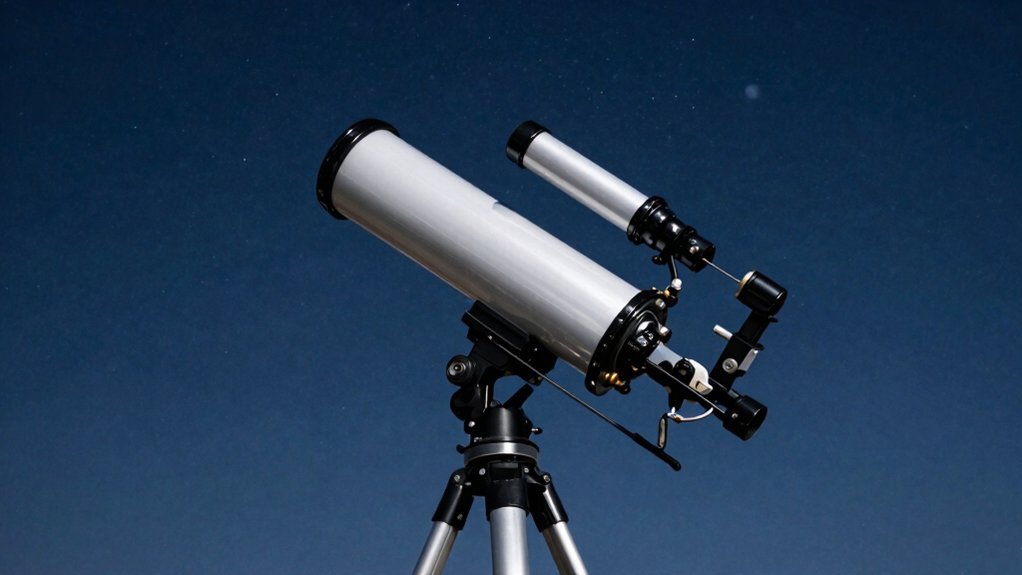
You’re wondering what makes a Schmidt Cassegrain Telescope tick, and honestly, it’s the clever folded light path that packs a long focal length into a short tube. This design uses mirrors and a corrector plate to hit f/10, making it perfect for travel and sharp planetary views. Obviously, you’ll need occasional collimation to fix minor distortions, but the compact size is unbeatable. Keep exploring to master its unique maintenance tricks.
What Defines a Schmidt Cassegrain Telescope?
That folded light path inside the tube is what makes this telescope so special. You’re probably wondering how such a short tube delivers such long focal lengths. It’s all about those clever design features packing power into a compact body.
You get a catadioptric system blending mirrors and a corrector plate seamlessly. This Schmidt-Cassegrain setup uses spherical primary and convex secondary mirrors effectively. The front plate fixes spherical aberration while supporting the secondary without spider vanes.
These optical systems create an f/10 instrument perfect for visual astronomy or imaging. You hold a portable powerhouse that outperforms much longer reflectors easily. Obviously, the central hole in the primary lets light exit the rear smoothly.
Now you understand why astronomers love this versatile, closed-tube architecture so much. Ready to see exactly how that light actually travels through the system?
This design effectively reduces spherical aberration while maintaining a manageable physical length for high-magnification viewing. When comparing options, selecting the right telescope type depends on your specific viewing goals and budget constraints. Unlike open-tube designs, the sealed structure minimizes air currents and protects the internal optics from dust and moisture.
How Does the SCT Folded Light Path Work?
Since you’re wondering how light zigzags inside such a short tube, let’s trace that journey together. Light enters through the Schmidt corrector plate, which fixes blurry edges immediately. It then hits the big concave primary mirror at the very back of your scope.
Now, watch those essential light reflections bounce forward toward the small convex secondary mirror. This tiny mirror sends the beam right back through a hole in the primary. You get folded optics that pack a long focal length into a tiny package. Obviously, this design lets you achieve high magnification without lugging around a massive tube.
Here’s the thing: your telescope tube stays roughly twice as wide as it is long. The light travels far internally while the physical structure remains compact and manageable. You enjoy convenient rear access for cameras or eyepieces thanks to this clever internal routing. This specific path makes your observing setup both powerful and surprisingly portable for travel. The integrated secondary mirror within the corrector plate ensures stable collimation even after extended exposure to varying weather conditions. By utilizing this folded optical path, the telescope achieves a long effective focal length while maintaining a physically short tube assembly. This unique configuration relies on spherical aberration correction provided by the aspheric corrector plate to deliver sharp images across the entire field of view. The combination of mirrors creates a compact optical system that significantly reduces the overall weight compared to refractors of similar aperture.
Why Are SCTs Ideal for Portable Stargazing?
You’re probably wondering how a telescope with such a long reach fits into a car trunk. The secret lies in the folded optical path. An 8-inch SCT packs 2000mm of focal length into a mere 430mm tube. This design lets you carry serious aperture without the bulk of traditional reflectors.
Now, consider your travel logistics. Compact transport becomes effortless when your scope fits easily beside camping gear. You’ll find setup at dark-sky sites much faster than with long-tube instruments. The manageable size encourages frequent trips rather than leaving gear gathering dust at home. This portability ensures that thermal equilibrium is reached quickly, allowing for sharper views sooner after unpacking.
Here’s the thing: you also gain versatile usage from this single instrument. Whether hunting faint galaxies or capturing sharp lunar details, the SCT adapts instantly. You get high magnification and light-gathering power in one portable package. Obviously, this flexibility saves you from buying multiple telescopes for different nights. When comparing options, understanding the optics performance trade-offs ensures you select the right tool for your specific observing goals. This compact form factor is achieved because the primary mirror reflects light to a secondary mirror which then bounces it back through a hole in the primary to the eyepiece.
Your next observing session just got considerably easier to plan and execute.
What Optical Limitations Do SCTs Present?
Although you love the portability, you might wonder why those edge stars sometimes look soft or weirdly shaped. Here’s the thing: spherical mirrors create spherical aberration effects that blur sharpness if the corrector plate doesn’t perfectly match. Obviously, residual errors still happen occasionally.
Now, coma limitations make off-center stars look like tiny comets, ruining wide-field views. You also face field curvature challenges where your camera sensor can’t capture the entire curved focal plane sharply. Astigmatism issues further distort star shapes away from the center, limiting your imaging potential. Even under ideal atmospheric conditions, these optical flaws mean you need extra correctors for crisp photos. Your scope demands precise collimation too, since tiny misalignments wreck image quality quickly. Honestly, narrow fields suit visual work best here.
All right, these optical flaws mean you need extra correctors for crisp photos. Your scope demands precise collimation too, since tiny misalignments wreck image quality quickly. Honestly, narrow fields suit visual work best here.
You must accept these trade-offs for such compact power. While these aberrations are inherent to the design, understanding spherical aberration effects helps enthusiasts manage expectations and select appropriate corrective optics. To get the best view, you should also ensure you are observing under dark sky conditions to minimize light pollution interference. Ready to see who actually thrives with this specific design?
Who Benefits Most From an SCT Design?
So, who actually gets the most out of this specific design? You benefit if you crave versatility without hauling massive gear. Traveling astronomers love the compact tube delivering long focal lengths easily.
Your observing styles dictate whether this scope fits your nightly routine perfectly. Planetary watchers gain huge SCT advantages like high magnification in a short package. Imagers appreciate the flexibility for both deep-sky shots and lunar details.
You save space while still grabbing large apertures for faint objects. Beginners often find this all-in-one solution ideal for learning the ropes. Obviously, you won’t get the widest fields, but the trade-off works.
This design shines when you need one telescope for everything under the stars. Ready to see how maintenance keeps your optics performing at their peak?
How Do You Clean and Align SCT Optics?
You’ve probably wondered if scrubbing that dusty corrector plate will actually ruin your views. Obviously, you should avoid cleaning unless absolutely necessary to prevent scratches. First, blast loose debris away with a blower bulb before touching anything.
Now, apply gentle cleaning techniques using pre-wetted, lint-free pads. Start at the center and wipe outward in smooth radial strokes. Never flood the optic or let liquid seep into the cell seams. When dealing with stubborn grime, use a soap solution while continuing to dab rather than wipe to avoid scratching the mirror. Always ensure your cleaning tools are free of dust to prevent introducing new abrasions during the process.
Here’s the thing: alignment tips matter just as much as cleanliness for sharp stars. Defocus a bright star until it looks like a donut shape. Check if the secondary shadow sits perfectly centered within that ring. Adjust the screws in tiny one-eighth turns to fix any offset. Keep the star centered in your field while making these micro-adjustments. Regular maintenance of your optical coatings ensures maximum light transmission and contrast for every observation session. Proper storage in a dry environment prevents moisture damage that can degrade performance over time.
Your optics stay sharp when you treat them with extreme care. Ready to test your newly aligned scope on a deep-sky target?