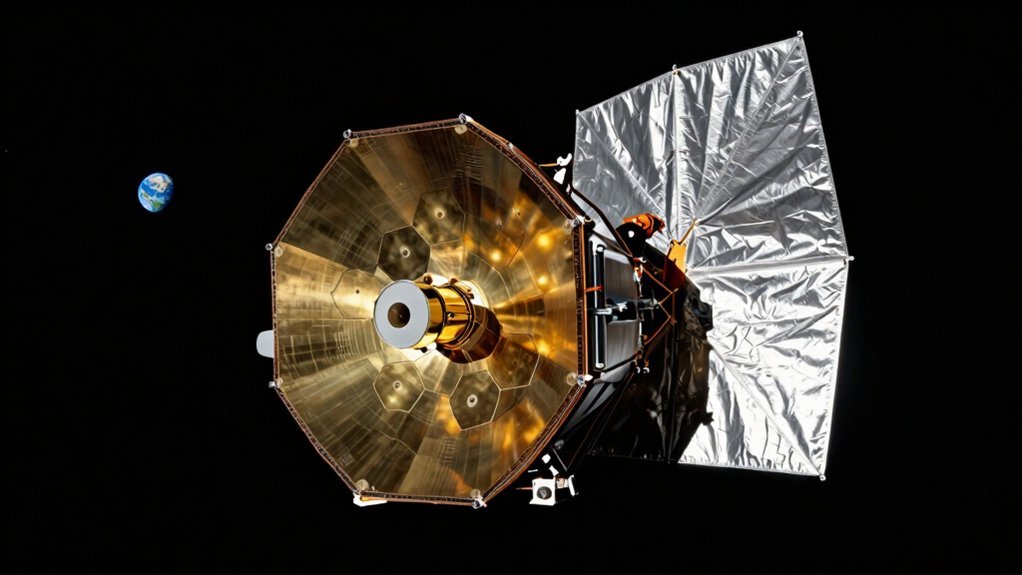
You’re wondering how giant dishes turn invisible cosmic whispers into clear pictures. Obviously, radio waves are much longer than light, so you need huge collectors to catch them. The dish focuses faint signals onto an antenna, where amplifiers boost tiny voltages thousands of times per second before digitizing them. Now, computers stitch these numbers into maps revealing cold dust clouds and black holes. Stick around to see how linking multiple dishes creates a telescope the size of Earth.
How Do Radio Telescopes Differ From Optical Ones?
Since you’re wondering how these giant dishes differ from the shiny tubes at observatories, you’ve hit on the core of modern astronomy. You see, wavelength differences dictate everything about their design and function. Radio waves stretch far longer than visible light, so your dish must be huge to catch them effectively.
Now, consider detection methods. Optical scopes focus photons directly onto cameras, but radio telescopes need antennas plus heavy electronic amplification. You can’t just snap a picture; computers must process those faint signals first. Obviously, this lets you observe day or night since sunlight doesn’t drown out radio waves.
Here’s the thing: optical tools show hot stars, while radio dishes reveal cold dust clouds hidden from human eyes. Both funnel radiation to a focal point, yet their hardware differs wildly. You gain access to a completely invisible universe by switching instruments. While optical designs vary by optics type to suit different stargazers, radio structures rely on massive surface areas to capture long wavelengths. Unlike optical models that balance cost and performance for every stargazer’s needs, radio arrays prioritize signal collection area above all else. In contrast to these specialized radio giants, beginners often start their journey by selecting among three main telescope types based on their specific viewing goals and budget. Ready to explore why size matters so much for these massive receivers?
Why Do Radio Dishes Need to Be So Large?
You’re staring at those massive dishes and wondering why they can’t just be smaller, right? Well, radio waves from space are incredibly faint, so you need a huge bucket to catch them. A larger aperture size grabs more energy, boosting your signal above the noisy background.
Now, consider that radio wavelengths stretch far longer than visible light does. You physically need a bigger dish to sample these long waves effectively. Without enough width, your telescope suffers from wave interference that blurs distant stars together. Just as optical telescopes rely on lens quality to focus light, radio instruments depend on precise surface accuracy to reflect long wavelengths to the receiver without distortion. This fundamental difference in wave behavior dictates that the angular resolution of a radio telescope is inherently lower than that of an optical instrument unless the dish size is vastly increased.
All right, think about resolution too. Small dishes smear nearby objects into one messy blob, while giant ones reveal crisp details. You simply cannot see fine cosmic features without that massive collecting area working for you. To maintain sharp imagery across these vast wavelengths, engineers often rely on aperture synthesis to simulate a telescope the size of the distance between individual dishes.
How Are Weak Cosmic Signals Converted to Data?
Imagine catching a whisper from across the galaxy and turning it into numbers you can actually read. Your dish focuses those faint waves onto an antenna, creating a tiny voltage. You need serious signal processing to make sense of such weak electrical murmurs before they vanish.
Now, your system samples this analog stream, rounding values into binary code computers understand. Digitizing right near the feed guarantees data preservation by cutting cable losses and timing errors. You store these raw IQ samples so future tools can reanalyze them without losing detail. According to the Nyquist Shannon theorem, the sampling rate must exceed twice the highest frequency in the signal to accurately capture cosmic data without aliasing.
Frequency transforms then split your signal from noisy interference, revealing hidden cosmic patterns. Software isolates specific bands, like the hydrogen line, while filtering out earthly radio static. You end up with clean digital records ready for deep scientific scrutiny. This conversion turns invisible waves into actionable astronomical insights you can finally study. Successful observation also depends on choosing a site with minimal radio interference to ensure the weakest cosmic whispers are not drowned out by local noise. Just as optical astronomers evaluate telescope optics to maximize light gathering, radio engineers must optimize their receiver systems to detect these faint cosmic signals effectively. Much like selecting the right aperture in optical instruments, the dish diameter of a radio telescope directly determines its ability to resolve fine details and collect weak signals from distant sources.
What Role Does Amplification Play in Detection?
Although your antenna catches cosmic whispers, that tiny electrical current vanishes without serious help. You need massive gain, often by factors of millions, just to measure anything.
Here’s the thing: early amplification types define your entire detection success. Low-noise amplifiers boost weak signals while adding minimal static, preserving that fragile data. Obviously, noise added now gets multiplied later, potentially hiding cosmic sources completely.
You rely on strict noise control because receiver electronics generate their own interference. Cryogenic cooling often helps reduce thermal noise in ultra-sensitive front-end designs. This balance guarantees your signal-to-noise ratio stays high enough for reliable recording. Visualizing how thermal noise disrupts weak signals clarifies why cooling is essential for maintaining data integrity. Following a step-by-step walkthrough ensures you implement these cooling and amplification strategies correctly from the start.
Amplification doesn’t create new information; it simply makes the original signal detectable. Your telescope’s sensitivity depends entirely on this critical first electronic stage working perfectly.
Now you understand why amplification matters before digitization happens next. For those seeking expert-backed guidance, applying these practical insights ensures your equipment performs at its peak potential.
How Is Analog Signal Turned Into Digital Info?
You’ve got that boosted signal, but your computer still can’t read it because it’s just a wavy analog current. Obviously, machines need numbers, not waves. That’s where analog conditioning steps in to clean and strengthen your waveform before sampling.
Now, the analog-to-digital converter samples this voltage thousands of times per second. This rapid signal digitization turns continuous variations into discrete numeric values your processor understands. High sample rates capture those broad radio frequencies accurately without losing essential data.
Once converted, systems immediately time-stamp these numbers to keep everything perfectly synchronized across arrays. Digital data travels easily over Ethernet links without degrading like fragile analog cables do. You now hold a clean, numeric stream ready for deep scientific analysis. Understanding signal processing ensures you can distinguish between instrumental noise and actual cosmic sources during this critical conversion phase. Just as selecting the right optical aperture is vital for telescope selection, choosing appropriate sampling parameters determines the fidelity of your radio observations. Much like how clear viewing conditions are essential for spotting faint stars with the naked eye, a stable environment minimizes interference during signal conversion.
Your raw cosmic whispers are finally readable code. Ready to see how single dishes build detailed sky images from this data?
Can Single Dishes Create Detailed Sky Images?
Can a single dish really snap a detailed picture of the sky? You might expect an instant snapshot, but you actually get a scan. Your telescope acts like a single-pixel detector, measuring brightness from one direction at a time.
Here’s the thing: you move the dish across the sky to build your image. As Earth rotates, your target drifts through the beam, letting you stitch together scan lines. This process creates a brightness map rather than a standard photograph. Obviously, your resolution depends on your dish size and the wavelength you observe. Unlike interferometers that rely on discrete baselines, your system utilizes a continuous baseline distribution from zero to the dish diameter to effectively capture large-scale structures.
Now, consider single dish imaging for survey mapping. You excel at capturing large-scale emission that other systems often miss. Your data reveals diffuse structures in galaxies that tiny details might hide. While you can’t match the fine detail of linked antennas alone, your wide view is essential. Combine your maps with other data for the clearest possible sky picture.
How Does Interferometry Link Multiple Antennas?
So how do you actually link separate dishes to act as one giant eye? You connect two or more antennas to combine their signals into a single observing system. Each dish catches waves from slightly different spots, creating tiny arrival-time differences you must fix.
Now, a correlator performs signal correlation to align these waves perfectly before they blur together. This process preserves essential phase and amplitude data, turning raw inputs into clear visibility measurements. Obviously, precise timing keeps everything sharp rather than smeared.
Here’s the thing: your resolution depends entirely on baseline optimization across the whole array. Longer separations mimic a giant telescope diameter, revealing finer details while shorter ones catch big structures. Adding more antennas creates diverse baselines, filling gaps in your final image reconstruction.
You effectively synthesize a massive aperture by merging many small samples mathematically. While optical stargazers must choose the right telescope based on specific needs, radio astronomers build virtual giants by linking many small dishes together. Understanding signal processing techniques is crucial for converting these combined radio waves into the detailed images we see. Just as selecting the correct instrument relies on your goals and budget, designing an interferometer requires balancing cost against the desired imaging capability. Ready to see how Earth’s spin further refines this picture?
Why Does Earth’s Rotation Improve Resolution?
All right, you’re wondering how a static array of dishes captures finer details without physically moving closer together. Earth rotation actually changes your baseline projection, letting you sample new spatial frequencies over time. As telescope tracking keeps the source centered, the sky effectively turns beneath your fixed antennas.
This movement fills your u v coverage with curved tracks, revealing finer angular details you’d otherwise miss. Longer observation time means more delayed measurements, which directly reduces annoying imaging artifacts in your final data. You fundamentally synthesize a much larger telescope just by waiting while the planet spins.
Your synthesized images become sharper because you’ve captured multiple viewing angles without moving a single dish. Obviously, more coverage equals better fidelity and fewer gaps in your reconstructed sky map. Now you see why patience yields such incredible resolution for your radio astronomy projects. By following practical steps in your observation planning, you ensure that every moment of Earth’s rotation contributes effectively to your final image quality. This technique relies on Earth rotation synthesis to mathematically combine data points into a single high-resolution map.
How Does Software Remove Noise From Signals?
Since your raw telescope data mixes target signals with messy background noise, you’re probably wondering how software separates them without losing the good stuff.
Now, background subtraction strips away broad interference first, creating a cleaner input for deeper analysis. This step isolates smaller features that noise otherwise hides.
Next, wavelet transforms split your signal into scales, letting algorithms threshold high-frequency junk while preserving real data. Mathematical morphology then cleans up scattered bits left behind.
All right, AI takes this further by learning specific noise patterns like radar or power lines. These adaptive systems can improve clarity by 20 dB in just 150 milliseconds. While originally designed for amateur radio, similar AI technology now processes astronomical data to filter out common interference types in real-time.
You see, effective noise reduction techniques and smart signal processing methods work together as a pipeline, not just one filter.
Obviously, preserving your intended astronomical signal remains the central goal during every cleaning step.
Ready to see what these cleaned signals actually reveal about the cosmos?
What Do Final Radio Maps Reveal About Space?
You might wonder what those cleaned signals actually look like once the noise vanishes. These final radio maps reveal the vast cosmic web, showing galaxy clusters invisible to optical telescopes. You see hidden structures because radio waves pierce through thick interstellar dust clouds easily.
Now, consider how these maps track black hole dynamics via powerful jets shooting relativistic particles. Strong radio emissions highlight where supermassive black holes shape entire galaxies over billions of years. Obviously, these energetic processes stand out clearly against the dark background of space.
All right, look at star formation regions glowing brightly within your new map. Magnetic fields guide charged particles here, exposing young stellar nurseries often obscured by dust. Recent surveys even catalogued 13.7 million sources, proving how much we missed before. The latest low-frequency imaging specifically identifies supernova remnants to help us understand the history of star formation within the galaxy.
Your final takeaway? Radio maps transform invisible data into a vivid portrait of our energetic universe. What specific cosmic mystery will you explore next with these powerful tools?