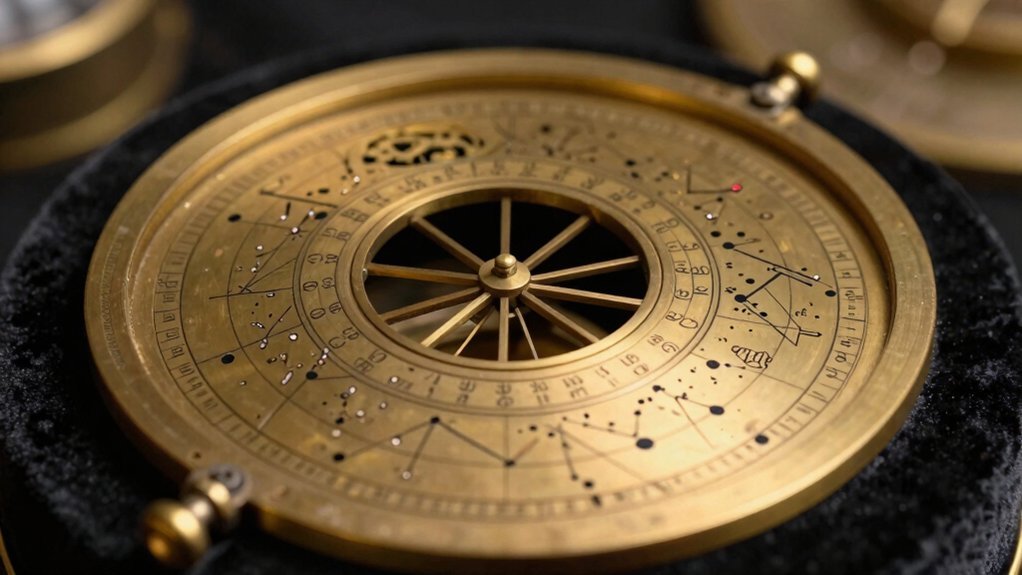
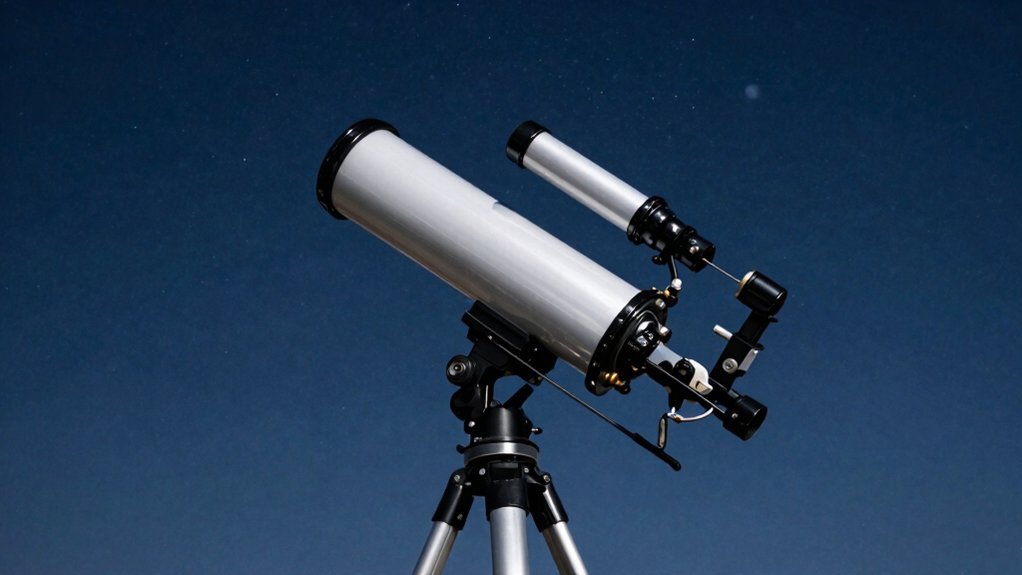
You’re wondering why mirrors beat lenses, right? Obviously, reflectors dodge color blur because mirrors bounce all light wavelengths equally, giving you sharp, true-color views. Now, bigger mirrors grab far more light than lenses, revealing faint galaxies that small scopes miss. Here’s the thing: making huge lenses is pricey and heavy, but mirrors scale up easily without breaking your budget or back. If you keep exploring, you’ll see exactly how these design choices unleash the deep sky.
Why Do Reflecting Telescopes Deliver Sharp, Color-Free Images?
If you’ve ever wondered why those bright planets don’t show weird color fringes in a reflector, you’re asking exactly the right question. Mirrors reflect every wavelength at the same angle, so light never splits like it does in glass lenses. This design completely eliminates chromatic aberration, giving you crisp views without those annoying purple halos.
Now, consider how this boosts your viewing experience. You get superior color accuracy because the spectrum stays perfectly unified from edge to edge. The absence of false color directly enhances image fidelity, making lunar craters look incredibly defined and sharp. Obviously, this means brighter stars appear as tight points rather than blurry smudges.
Here’s the thing: mirrors deliver truer images simply by bouncing light cleanly. You see celestial details exactly as they exist, free from optical distortion. This sharpness comes straight from the mirror design, not extra coatings. By avoiding the heavy glass required for large lenses, this optical setup allows for a much more compact telescope structure while maintaining a large aperture. Unlike refractors that suffer from light absorption within thick glass, reflectors maximize light gathering efficiency to reveal fainter deep-sky objects. Since mirrors can be supported from behind, they avoid the sagging issues that plague large lenses, ensuring optical stability remains high even in massive apertures. Ready to see how size changes what you can find?
How Do Larger Apertures Uncover Faint Deep-Sky Objects?
You just saw how mirrors kill color fringes, but now you’re wondering how to spot those incredibly dim galaxies. Here’s the thing: bigger mirrors grab far more photons than small ones do. This huge light-gathering power directly boosts your faint visibility of distant nebulae.
Obviously, deep-sky targets need every bit of collected light to stand out. You get clearer views of star clusters because larger apertures improve contrast against the dark sky. These specific aperture benefits make dim features pop right out at you.
Reflectors let you build massive mirrors cheaply, so you access sizes refractors can’t match. You simply see more detail in faint objects when your telescope gathers more light. That extra brightness reveals galaxies that smaller scopes miss completely. By prioritizing aperture size over magnification, enthusiasts can maximize the detection of low-surface-brightness objects that would otherwise remain invisible. Unlike refractors which suffer from chromatic aberration, reflectors utilize a single mirror design to ensure all wavelengths focus at the same point, preserving image sharpness across the entire field of view. Since mirror support structures are simpler than lens cells, this engineering advantage allows for the construction of large diameter mirrors that provide superior resolution for deep-sky observation.
What Makes Refractors More Expensive Than Reflectors?
Since you’ve seen how reflectors handle big apertures so well, you’re probably wondering why refractors cost so much more. Here’s the thing: optical manufacturing for lenses demands perfection across two surfaces, not just one like mirrors. You need flawless glass quality because light travels through the entire thick lens, exposing every tiny internal defect.
Obviously, fixing color fringing adds huge expense too. Refractors require complex glass combinations to stop rainbow halos, while reflectors naturally avoid this issue entirely. Large lenses also sag under their own weight, needing expensive edge supports that mirrors simply don’t require. Unlike mirrors which can be supported from behind to prevent deformation, lenses must rely solely on their rims, making structural support a significant engineering challenge for large refractors.
Scaling up makes prices skyrocket for refractors but stays reasonable for reflectors. You pay a premium for that pristine, unobstructed view through perfect glass. This cost difference is why large aperture reflectors remain the most accessible option for beginners seeking deep-sky views. Now you understand the real cost drivers behind those sleek tubes. Ready to see how compact designs fit your small space? The optical design of reflectors allows them to achieve larger light-gathering capabilities at a fraction of the price compared to equivalent refractors.
Why Do Compact Reflector Designs Suit Small Spaces?
Two key tricks let reflectors squeeze big optics into tiny rooms. You often wonder how huge mirrors fit on small balconies without tipping over. The folded light path shortens the tube dramatically compared to long refractors.
Now, this compact design lets you store powerful scopes in closets easily. You gain large apertures without needing massive floor space or high ceilings. Lightweight structures further help because mirrors weigh far less than giant lenses.
Here’s the thing: you can carry these setups up stairs without struggling. Less mass means your tripod stays stable even in tight corners. Obviously, easier mounting from the mirror’s back simplifies your whole setup process.
You get serious light-gathering power while keeping your observing area uncluttered. This practical balance makes reflectors perfect for apartment astronomers with limited room. By utilizing folded optical paths, the physical length of the instrument is reduced without sacrificing focal length or image quality. Unlike refractors, these designs avoid chromatic aberration entirely since mirrors reflect all wavelengths of light equally. Additionally, the open tube design allows for faster thermal equilibrium so the telescope cools down quickly in small indoor spaces. Ready to see how those mirrors actually collect so much light?
How Do Professional-Grade Mirrors Enable Massive Light Gathering?
When you wonder how pros catch faint light, it’s all about that massive mirror area. You see, light-gathering power scales directly with surface area, not just diameter. An 8-inch reflector gathers far less than a 12-inch model, which collects more than double the photons. Obviously, bigger mirrors intercept wider cones of incoming rays, boosting image brightness considerably.
Now, consider how professional mirror coatings preserve every single photon you need. High-quality silver or aluminum layers reflect about 90% of incident light, maximizing your system’s light efficiency. Unlike lenses, mirrors avoid transmission losses because light never passes through thick glass. This design keeps thermal loads low while delivering sharp, bright images across wide spectral ranges.
Here’s the thing: scaling up mirrors remains easier than building huge lenses for observatories. You get massive apertures without the weight penalties of transmissive optics. Ready to explore how this affects your view of deep space objects? To truly appreciate these views, you must first understand observing conditions that determine what is realistically visible in the night sky.