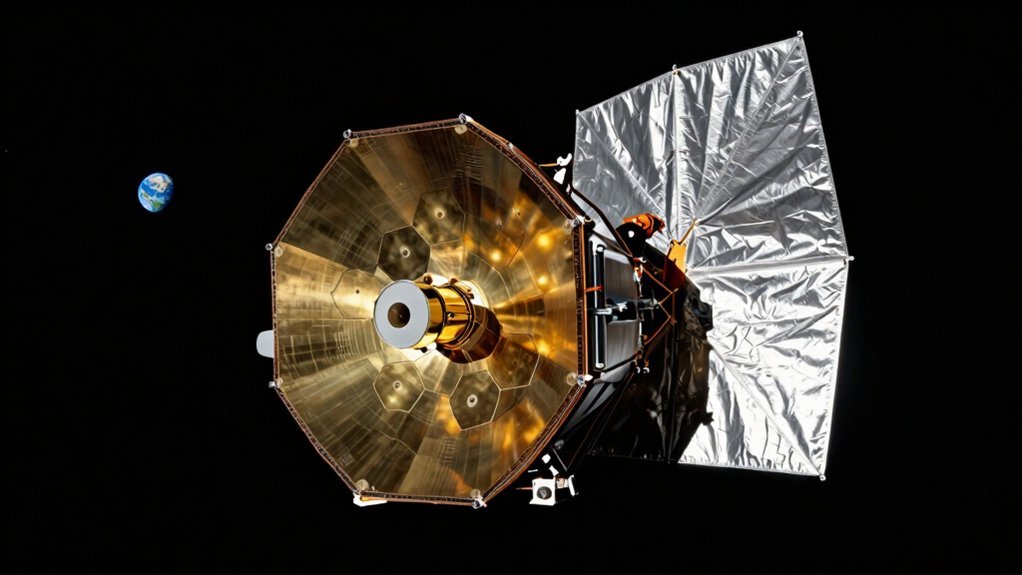
You’re wondering why telescopes matter, and it’s because your eyes simply can’t gather enough light to see the universe’s faintest secrets. Obviously, a big mirror acts like a giant bucket, collecting half a million times more photons than your pupils ever could. Now, this huge aperture lets you spot dim galaxies while also sharpening details your naked eye misses. Stick around to uncover exactly how these tools measure the cosmos’s true age.
Why Telescopes Gather More Light Than Eyes
You’re wondering why your eyes miss so much while a telescope catches it all. Your pupils act like tiny buckets, catching few photons in a split second. Telescopes use massive mirrors to scoop up vastly more light from distant stars instantly.
Now, consider your eye’s limited exposure time of just one-fifteenth of a second. Cameras attached to scopes gather light for minutes, accumulating signals your brain never sees. This combination of huge area and long exposure time creates incredible light gathering power.
Here’s the thing: a big telescope collects half a million times more light than you. It focuses those gathered photons sharply, making faint glows bright enough to study clearly. You simply cannot match that optical efficiency with biological eyes alone, no matter how hard you try. The total amount of light collected is directly determined by the aperture size of the instrument’s primary lens or mirror. When selecting an instrument, understanding the trade-offs between different optical designs helps match the telescope to your specific stargazing goals and budget. Choosing the right optical design ensures you balance performance needs with your available budget for the best stargazing experience.
How Larger Apertures Reveal Fainter Objects
Since your eyes miss so much, you’re probably wondering how a bigger tube actually finds those ghostly smudges in the sky. Here’s the thing: doubling your aperture doesn’t just double the view; it quadruples your light collection power instantly. You gather four times more photons, making dim galaxies pop against the dark background easily.
Obviously, this massive jump explains why aperture benefits matter so much for deep-sky hunting. A small 50mm scope hits magnitude 10.5, but a 200mm beast reaches 13.5 effortlessly. You suddenly detect faint star clusters previously hidden by sky glow and noise. More photons mean you see weak features inside nebulae that smaller instruments simply cannot reveal. This capability is defined by the limiting magnitude, which represents the faintest object a telescope can detect based entirely on its aperture size. When selecting equipment, understanding the trade-offs between optical design types ensures you choose a telescope that balances light-gathering power with portability and cost for your specific stargazing goals. Different optical configurations also affect image contrast and maintenance needs, making reflector telescopes a popular choice for beginners seeking maximum aperture per dollar. Additionally, the specific focal ratio of your chosen instrument will determine the brightness of extended objects and the overall field of view available for observation.
Why Bigger Telescopes Provide Sharper Details
Diffraction blurs your view, turning sharp points into fuzzy smudges. You wonder why size matters so much for clarity. Here’s the thing: the diffraction limit dictates your maximum image sharpness. Smaller openings spread light wildly, creating annoying blur everywhere you look.
Larger apertures crush this blur, boosting your angular resolution greatly. You separate close stars easily because bigger mirrors focus collected light tighter. Obviously, doubling your mirror diameter quadruples the area gathering those precious photons. Your optical systems deliver crisper planet details without just magnifying fuzz.
Practical observing proves that aperture beats raw magnification every single time. A ten-inch scope shows lunar cracks a tiny glass simply cannot resolve. You gain exquisite detail because the system concentrates light into smaller patterns. The physics of wave interference explains why light bends around edges to create these limiting patterns. Atmospheric turbulence often degrades this theoretical limit, but adaptive optics can correct such distortions in advanced systems.
Bigger truly means sharper for your night sky adventures. Understanding light-gathering power reveals why larger instruments detect fainter objects that smaller ones miss entirely. Now, consider how these tools capture invisible waves next.
How Telescopes Detect Invisible Light Waves
You’ve probably wondered why astronomers bother with light you can’t even see. Well, most universe energy hides outside your narrow vision range. Specialized tools capture these invisible waves to reveal hidden cosmic secrets.
Infrared technology sees heat through dust clouds where stars are born. Ultraviolet sources glow from hot young stars that atmosphere usually blocks. Radio frequency receivers collect long waves to map cold gas structures. X-ray detection spots violent explosions near black holes with high energy. Gamma ray exploration tracks the most powerful blasts across deep space.
Each wavelength tells a unique story about physical conditions out there. You need different mirrors and detectors for every specific wave type. Space telescopes avoid atmospheric distortion to catch UV, X-rays, and gamma rays. Ground radio dishes gather faint signals using massive collecting elements effectively. Different wavelengths reveal unique perspectives of celestial objects that visible light alone cannot show. Advanced observatories utilize adaptive optics to correct atmospheric blurring and sharpen images from the ground. Choosing the right instrument depends on understanding light gathering power to ensure faint cosmic details are captured clearly. The aperture size directly determines how much light the telescope can collect to view these faint signals.
Now you understand how scientists observe the full electromagnetic spectrum daily. Ready to uncover what faint objects these tools actually find?
What Faint Objects Can Telescopes Discover?
Two main factors decide exactly what faint objects you can reveal: your telescope’s aperture and the darkness of your sky. You’ll spot faint galaxies as fuzzy patches, while larger scopes reveal spiral hints in giants like M81. Obviously, dark skies help you catch those elusive dwarf galaxies too.
Now, consider faint nebulae glowing softly against the void. Filters boost contrast so you see emission clouds clearly. Without city glow washing them out, these diffuse objects truly shine. By blocking specific wavelengths of light pollution, filters allow the faint glow of nebulae to stand out against the brightened sky background.
You also resolve faint star clusters into individual stars with enough magnification. Averted vision helps your eye catch dim members in crowded fields. Thirty minutes of dark adaptation makes a huge difference here.
Ultimately, you unveil hidden universe layers through better light collection. Your next step involves choosing the right filter for specific targets. To ensure success from the start, beginners should focus on mastering the basics before attempting complex observations.
How Telescopes Measure the Universe’s Age?
Since you’re wondering how we actually time the cosmos, you’ve asked the perfect question. Telescopes track galaxy speeds and distances to calculate expansion rates. Faster expansion means a younger universe, while slower rates suggest an older one.
You rely on Cepheid stars as cosmic yardsticks for these critical cosmic measurements. Their pulsing light reveals true brightness, letting astronomers gauge vast intergalactic distances accurately. This data calibrates supernovae, extending our reach across the expanding universe effectively. Advanced optical coatings on modern telescope mirrors maximize light collection, ensuring the faint signals from these distant stars are captured with minimal loss.
Now, scientists also analyze ancient radiation patterns to refine this age estimation process. Combining these methods pins the universe’s age at roughly 13.8 billion years. You see how precise tools transform vague guesses into solid scientific facts today. Following a step-by-step walkthrough of these observational techniques ensures beginners understand the logical progression from raw data to final calculation. Just as a well-structured web page guides users clearly, this methodical approach prevents confusion when interpreting complex astronomical data.
This clarity helps you grasp our origins without getting lost in complex math. Next, you might ask why ground-based views sometimes blur compared to space observations.
Why Space Telescopes Avoid Atmospheric Blur
When you wonder why ground views blur, you’re spotting the atmosphere’s fault. Air isn’t still; moving layers bend starlight unevenly, creating smear instead of sharp points. This atmospheric turbulence makes stars twinkle but ruins your view through a telescope.
Now, space telescopes float above this messy air entirely. They capture light before wind distorts it, delivering incredible image clarity you can’t get from Earth. Hubble reaches its diffraction limit because nothing blocks its path, unlike ground scopes limited to one arcsecond resolution before adaptive optics.
Here’s the thing: space avoids clouds, storms, and city glow too. You get steady, dark skies forever without weather interruptions ruining your long exposures. While ground tech helps, orbiting instruments still win for pure, uncorrected sharpness across the spectrum. Even from Earth, finding a location with minimal light pollution significantly improves what a beginner can see, though it cannot match the vacuum of space. Modern observatories utilize adaptive optics to counteract some atmospheric distortion, yet they still rely on space-based platforms for the most pristine data. Selecting a telescope with a larger aperture size allows ground-based observers to gather more light, partially compensating for the loss of detail caused by atmospheric interference.
You now see why leaving Earth matters for crisp cosmic photos. Next, consider how this clarity reveals the universe’s true age.