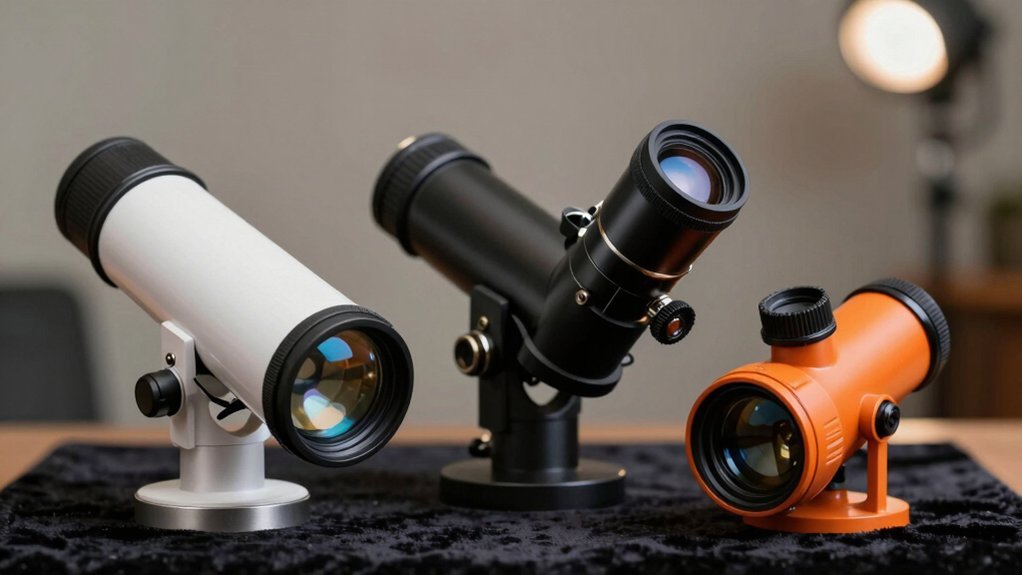
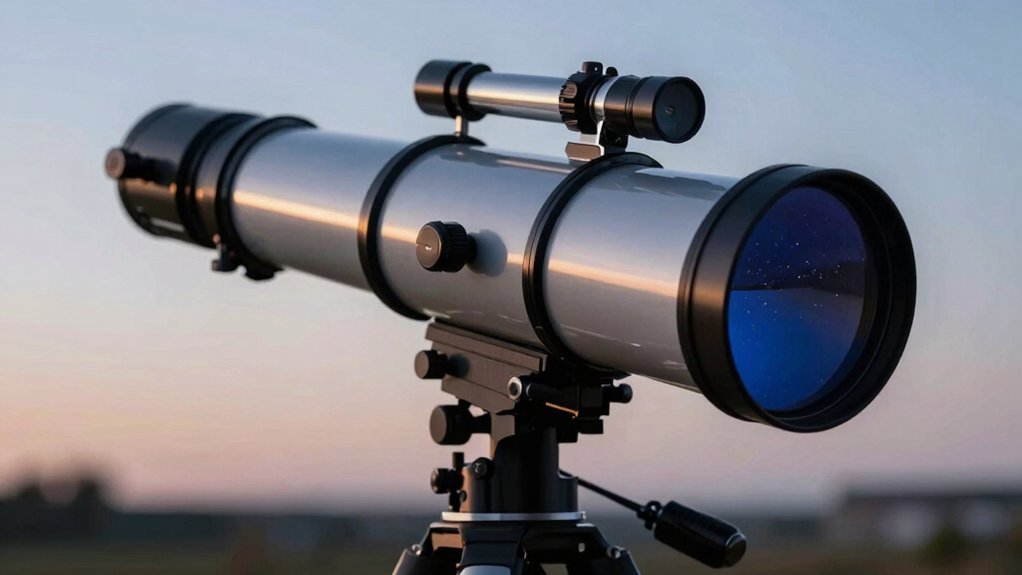
You’re confused because cheap scopes frustrate while expensive ones feel wasteful. Here’s the thing: you need $200 to $400 for real quality. Avoid anything under $100 since shaky mounts ruin views faster than bad glass. Obviously, aperture matters most for gathering light on faint objects. Stick to stable Dobsonians or refractors within this range to see craters clearly. You’ll unveil exactly which model fits your specific night sky goals next.
What Can You See Within Your Telescope Budget?
How much sky can you actually afford on a tight budget? You might think cheap glass shows nothing, but that’s wrong. The Moon dazzles even in sub-$500 scopes with crisp craters and sharp shadows.
Mastering lunar observing techniques reveals mountain ranges and rilles easily. Urban skies don’t stop you from seeing these bright details clearly. Obviously, the Moon remains your most reliable target tonight.
Planetary visibility factors limit Mars, yet Jupiter still displays cloud bands. Saturn’s rings appear distinct, while Venus shows phases like our moon. You won’t see deep atmospheric swirls, but disks shine brightly.
Deep-sky objects like open clusters glow well in this price range. A six-inch aperture starts resolving globular clusters into individual stars under dark skies. Faint galaxies often look like smudges unless conditions favor your specific setup.
Aperture matters most for faint light, not fancy computer mounts or extras. You get acceptable views without premium optics costing thousands of dollars. Focus on light gathering power before worrying about advanced tracking systems. Computerized go-to mounts allow beginners to locate and track approximately 40,000 different objects within minutes. Understanding the differences between reflector and refractor designs helps you select the optical tube that best matches your observing goals and budget. Larger aperture size directly increases the amount of light collected, revealing fainter details that smaller telescopes miss. Refractors utilize lenses to gather light, making them ideal for high-contrast views of lunar and planetary targets with minimal maintenance required.
Ready to choose the right tube for your specific viewing goals?
Matching Telescope Types to Your Viewing Goals
You’re probably wondering which telescope actually fits your specific viewing goals. Different telescope types serve distinct purposes, so match them carefully.
Refractors excel at lunar and planetary views while doubling for daytime use. You’ll get sharp, high-contrast images perfect for birds or the Moon.
Reflectors and Dobsonians offer massive aperture for deep-sky objects like galaxies. They deliver wide fields ideal for browsing vast star clusters efficiently.
Portability matters if you travel often to dark sky sites regularly. Cassegrains stay compact, whereas large Dobsonians sacrifice ease of transport for light-gathering power.
Your magnification needs vary wildly between finding targets and examining details closely. Lower power helps locate objects before you switch to higher magnifications. Keep in mind that maximum useful magnification is roughly twice the telescope’s aperture in millimeters to avoid empty magnification. Understanding optical resolution limits ensures you select an instrument capable of revealing the fine details you seek. Proper maintenance of your optics ensures long-term image quality remains crisp despite environmental exposure. For beginners overwhelmed by complex setups, mount stability is often the deciding factor between a frustrating night and a successful observation session.
Aligning your equipment with these specific viewing goals guarantees satisfying observations every time. Now, are you ready to explore affordable options fitting your new plan?
Best Beginner Telescopes Under $300 and $500
Now that you’ve matched your goals to a telescope type, you’re probably staring at price tags wondering what’s actually possible. Under $300, you’ll find solid tabletop Dobsonians like the Sky-Watcher Heritage 130P. These scopes prioritize aperture over fancy telescope features, giving you brighter views for less cash. For those interested in capturing images, the Seestar S30 is a smart telescope option originally priced around $349 that simplifies astrophotography.
Jumping to the $500 range opens up larger mirrors and even computerized options like the Virtuoso GTi. You gain automation here, but remember that mount stability matters just as much as glass quality. Don’t forget to save room in your budget for essential budget accessories like extra eyepieces. Understanding how light gathering power works will help you appreciate why these larger apertures are so critical for viewing faint objects. While refractors offer sharp contrast, reflectors generally provide more aperture per dollar for deep-sky observing within this price range. Investing in a sturdy tripod or mount early on prevents frustrating vibrations that can ruin your view regardless of the optic’s quality.
Obviously, bigger apertures reveal more deep-sky detail regardless of the specific design you choose. Focus on getting the largest mirror or lens your money can buy right now. This approach guarantees you maximize your viewing potential before upgrading later. Ready to see how much glass you actually need for those faint galaxies?
Why Astrophotography Requires a Bigger Budget
If you’re wondering why astrophotography costs so much more than just looking through a scope, it’s because you’re building an entire imaging system, not just buying a telescope. You need a camera, mount, guidescope, and power gear. A basic widefield rig starts near $350, but deep-sky setups easily hit $2,700.
Here’s the thing: your mount eats the biggest chunk of cash. A stable equatorial mount alone costs $760 because precise tracking matters most. Cheap mounts fail quickly, ruining your long exposures and wasting money.
Obviously, you’ll want equipment longevity, so buying quality early saves pain later. Most astrophotographers tackle this via incremental upgrades, adding filters or better cameras over time. Don’t buy everything at once; start with one target type. This strategy keeps costs manageable while you learn complex imaging skills. Focus on mastering your current gear before expanding your expensive toolkit. While visual observers prioritize optics and performance, astrophotographers must invest heavily in mechanical stability to capture clear images. Unlike visual observing which can begin with just dark sky conditions, imaging demands a fully integrated hardware ecosystem to succeed. Understanding the role of aperture size is also critical, as it determines light-gathering capability and resolution for detailed celestial photography.
How to Choose Your First Telescope Without Overspending
How do you actually pick a scope without wasting cash on junk? You skip those cheap under-$100 models because they frustrate everyone immediately. Aim for the $200 to $400 range where real quality starts appearing consistently.
Now, understand aperture importance before buying anything else. Bigger mirrors gather more light, revealing faint details that tiny lenses simply miss. Target at least 70mm, but remember huge scopes get heavy fast.
Here’s the thing: mount stability matters just as much as glass quality. Shaky views ruin your night faster than bad optics ever could. Dobsonian designs often offer the best balance for beginners right now.
Avoid flashy magnification claims since they usually lie about actual performance. Match your choice to your storage space and specific observing goals instead. Don’t let marketing hype drain your wallet unnecessarily today.
Different telescope types offer unique advantages in optics and performance depending on whether you prioritize portability or deep-sky viewing capacity. For instance, light gathering power is directly determined by the aperture size, making it the most critical factor for seeing faint celestial objects clearly. Before heading out, ensure you find a location with dark sky conditions to maximize the visibility of stars and galaxies.