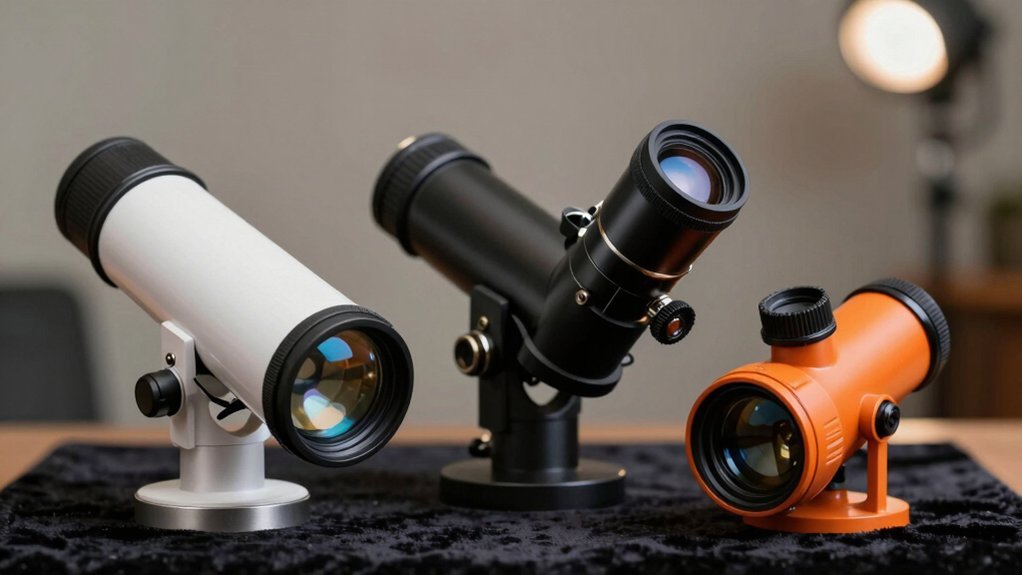
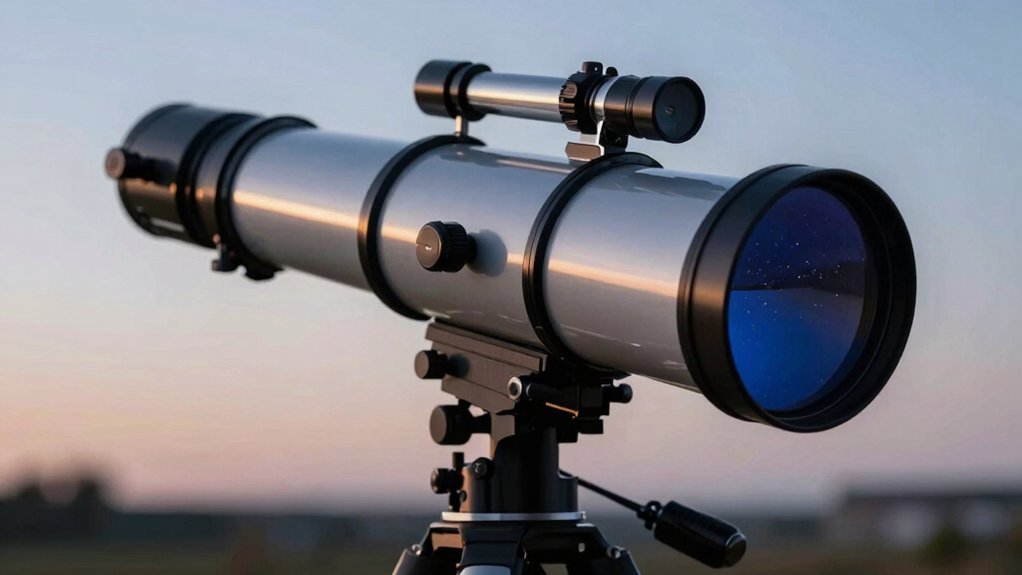
You’re confused because the names sound like rivals, but here’s the thing: a Dobsonian is just a Newtonian on a simple rocker box. You get huge mirrors for cheap with a Dob, perfect for visual stargazing without complex tracking. Obviously, you need a motorized equatorial mount if you want to photograph deep-sky objects instead. Your choice depends entirely on whether you value massive views or precise tracking. Keep scrolling to match your specific goals to the right setup.
Newtonian vs Dobsonian: Defining the Core Difference
Confusion often strikes when you see “Newtonian” and “Dobsonian” listed as separate telescope types. You might think they represent competing technologies, but that isn’t true at all. Actually, Newtonian describes the optical design using specific mirror technology to gather light.
Here’s the thing: a Dobsonian is simply a Newtonian tube sitting on a simple rocker-box mount. You get the same concave primary and flat secondary mirrors in both setups. The light path remains identical whether you call it one name or the other.
Obviously, the real difference lies in mechanics, not optics. A Newtonian can ride an equatorial mount, while Dobsonians almost always use Newtonian optics. Don’t let marketing terms fool you into buying twice. This distinction allows you to compare how mount stability affects your viewing experience alongside optics, performance, and cost. Following a practical step-by-step walkthrough ensures you get it right the first time when selecting your setup.
You now know these labels describe different parts of your scope. Ready to see how that mount changes your actual stargazing night?
Understanding the distinction between optical design and mount type is essential for selecting the right instrument for your observing goals.
How Mount Types Dictate Your Observing Experience
You just learned the optics stay the same, so why does your viewing night feel so different? It’s all about how mount types shape your observing styles. Dobsonians use simple alt-azimuth motion, making them perfect for easy visual experience while sweeping the sky.
Now, consider tracking behavior. Equatorial mounts counteract Earth’s rotation, keeping stars fixed without constant nudging. This changes your session feel dramatically during long looks at specific targets. Understanding optical alignment ensures that the mechanical stability of your mount translates directly into sharper, more consistent images.
Obviously, setup effort varies too. Dobsonians sit on the ground with no gears, offering fast deployment. Equatorial systems need alignment but provide steadier tracking for repeated viewing. Your choice dictates whether you browse freely or track precisely. The inherent mechanical stability of a well-built mount minimizes vibration, ensuring that high-magnification views remain steady even after accidental bumps.
Ultimately, the mount determines if you fight drift or enjoy steady views. Do you prefer manual simplicity or automated stability? That decision defines your next step in choosing the right telescope setup.
For those prioritizing portability alongside ease of use, understanding telescope weight and size is crucial before committing to a specific mount configuration.
Comparing Aperture and Cost Per Dollar
Everyone wants the biggest view for their buck, but you’re probably wondering why some scopes cost so much more for the same size. You see an 8-inch Dobsonian for $350, while an equatorial Newtonian costs far more. The mount drives this price gap, not the mirrors themselves.
Here’s the thing: Dobsonians deliver unmatched aperture advantage because simple rocker boxes save money. You get a 12-inch scope under $1,000, whereas other setups charge double. This cost efficiency lets you buy larger mirrors that gather nine times more light than small refractors. Obviously, bigger apertures reveal fainter details without draining your wallet. Unlike computerized mounts that require power and alignment, the manual alt-azimuth design keeps operation intuitive and portable for field use.
Now, consider that a 16-inch Dobsonian might cost $500 while traditional reflectors hit $3,000. You simply cannot beat this value proposition for visual observing on a budget. Prioritize aperture per dollar if you want maximum performance now. Ready to see why these big tubes dominate the night sky? While the mirror optics remain identical across these designs, the rocker box mount is the specific engineering choice that eliminates the need for expensive counterweights and tripods. This design philosophy ensures that optical performance remains the primary focus rather than complex mechanical tracking systems.
Why Dobsonians Dominate Visual Deep-Sky Observing
That massive aperture you just saved money on isn’t just a number; it’s your ticket to seeing the faintest cosmic clouds. You get huge light buckets because simple mounts keep costs low while maximizing mirror size. Obviously, more glass gathers more photons for those dim galaxies hiding in the dark. Now, consider how Dobsonian advantages transform your night sky experience. The wide fields frame entire nebulae perfectly, helping you star-hop easily without frustration. Simple alt-az bases offer rock-solid stability, so your views stay steady during long visual observing sessions. You spend less time setting up and more time scanning deep-sky treasures like never before. Here’s the thing: these scopes prioritize seeing over tracking. You witness intricate structures in clusters that smaller telescopes simply miss completely. This design remains the undisputed king for pure visual enjoyment under dark skies. Unlike refractors, this optical layout ensures no chromatic aberration occurs, preserving color fidelity across the entire field of view. The parabolic primary mirror focuses light to a single point to deliver sharp images even at fast focal ratios. While excellent for looking, the manual alt-azimuth mount lacks the motorized tracking required for long-exposure astrophotography. The simplicity of the design allows astronomers to invest in larger apertures rather than expensive mechanical tracking systems. Ready to see why imaging requires a completely different approach next?
Can Newtonians Track Stars for Astrophotography?
Can a Newtonian actually track stars for you? The tube itself doesn’t move; motorized mounts handle that heavy lifting. You need serious tracking accuracy to keep stars round during long exposures. Obviously, your optical performance shines brighter with steady support from quality gear.
Here’s the thing: exposure limitations define your astrophotography options greatly. Short clips work great for planetary versus deep sky targets. Planets need fast frames, while deep sky demands minutes of perfect stillness. Budget mounts often struggle here, limiting your imaging accessories’ potential. Because the telescope’s substantial weight creates balance issues that affect stability, a high-capacity mount rated for over 115 lbs is often necessary to prevent tracking failures during long sessions. Unlike Dobsonians which typically use simple alt-azimuth bases, Newtonians require an equatorial mount to effectively compensate for Earth’s rotation during astrophotography. Proper polar alignment of this mount is critical to minimize field rotation and ensure sharp images over extended periods. While alt-azimuth mounts are simpler to set up, they introduce field rotation that ruins long-exposure deep sky images unless corrected with additional hardware.
You’ll find Newtonians excel at planets where tracking errors matter less. Deep sky imaging requires premium mounts to prevent blurry trails. Don’t blame the telescope when your mount can’t hold steady. Your setup’s stability dictates success more than aperture size alone.
Choose your mount carefully before buying that big Newtonian tube. Ready to tackle the tricky alignment process next?
Setup Complexity and Alignment Requirements
While you might worry about complex gears, the Dobsonian’s simple base actually makes setup a breeze. You just place the base on level ground, seat the tube, and start observing immediately. Obviously, this straightforward workflow saves you precious time under the stars compared to fussy equatorial mounts.
However, both scopes need occasional mirror alignment to sharpen your views. You will use specific collimation tools like a Cheshire or laser to fix any optical drift. Mastering these basic alignment techniques guarantees crisp images after every bumpy car ride. This process ensures the primary mirror reflects light accurately to the eyepiece for optimal performance. The Newtonian design relies on this precise optical alignment to prevent blurry stars and maintain image quality. Unlike computerized mounts, these manual systems do not require power sources to function, making them ideal for remote dark-sky locations.
Don’t let this maintenance scare you off; it only takes minutes once you learn the steps. Your patience here directly rewards you with stunning, high-contrast planetary details tonight. Now that you understand the setup differences, are you ready to reflect on how easily these tubes fit in your car?
Portability: Will It Fit in Your Vehicle?
You’re probably wondering if that shiny tube actually fits in your sedan. Tube length dictates everything here, especially for solid Newtonians. A 48-inch focal length usually slides right into most car trunks without hassle. Smaller 150mm models weigh under 25 lbs, making them truly portable for you.
Now, larger Dobsonians present a different vehicle fit challenge entirely. The rocker box adds serious bulk, often exceeding the tube’s size. You must measure both pieces before loading up your SUV for the night. Truss designs break down smaller but demand extra assembly time at your site. While traditional solid tubes offer simplicity, truss tube designs provide a compact alternative for those needing to maximize limited cargo space.
Obviously, weight matters just as much as raw dimensions. Keep every single part under 30 pounds to save your back. If you can’t carry it easily, you won’t use it often enough. Prioritize compact mounts that simplify your overall transport package greatly today. Understanding the optical tube assembly dimensions ensures your chosen configuration aligns with your vehicle’s specific cargo capacity.
Does your current car truly handle the gear you actually need?
Which Telescope Suits Beginners Best?
So, which telescope actually makes sense for your first night under the stars? You probably wonder how different telescope types affect your stargazing success. Dobsonians win here because their simple rockerbox mounts let you point and look immediately. Newtonians often need complex equatorial mounts that demand tricky alignment steps before you see anything.
Beginner preferences usually favor big views without the headache. Dobsonians offer huge apertures for faint galaxies at prices other designs can’t match. You get more light-gathering power per dollar with these simple tubes. While Newtonians share the same optics, their fancy mounts cost extra and confuse new users.
Obviously, you want to observe, not fight equipment. An 8-inch Dobsonian balances size, price, and ease perfectly for starting out. You’ll track objects manually, but the simplicity keeps you looking up longer. Choose the scope that gets you outside faster tonight.
The Final Verdict: Matching Telescope to Your Goals
Since you’ve weighed the pros and cons, picking the right scope really comes down to your specific stargazing goals. Do you crave massive views of distant galaxies without breaking the bank? Then grab a Dobsonian. You’ll get huge aperture, maybe 16 inches, for incredible value. This design favors visual observing over complex tracking.
But perhaps you want to photograph those nebulae instead. You need a Newtonian on an equatorial mount. These telescope features allow precise tracking for long exposures. Obviously, this setup costs more money. You trade simplicity for imaging capability and mount flexibility.
Your final choice depends entirely on your observing goals. Want easy, high-impact viewing? Choose the Dobsonian rockerbox. Need research-style precision? Build a custom Newtonian system. Don’t buy gear that fights your actual hobbies. Match the tool to your night sky ambitions. Which path feels right for you?