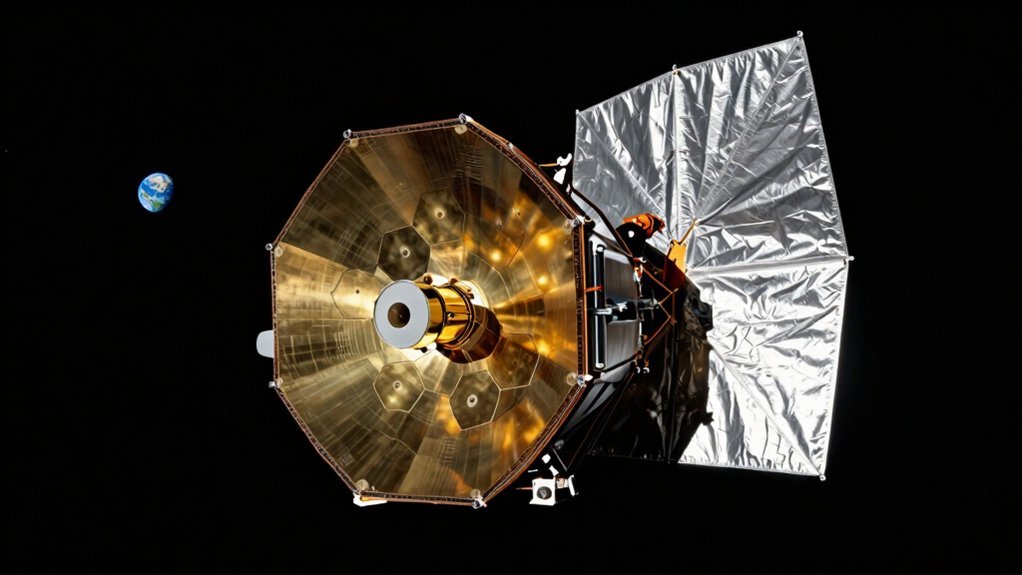
You’re wondering why Hubble matters when ground telescopes keep getting bigger, and the answer lies in its orbit above Earth’s blurry atmosphere. Now, you get images ten times sharper than any ground scope, capturing ultraviolet light that air blocks completely. Here’s the thing: this clarity let scientists measure cosmic expansion within one percent accuracy and spot galaxies from just 400 million years after the Big Bang. Obviously, that stable view changed everything we understand about dark energy. Stick around to see exactly how those crisp images rewrote our cosmic history.
Why Hubble Outperforms Ground Telescopes
Since you’re wondering why a smaller space telescope beats giant ground ones, you’ve asked the perfect question. Hubble delivers unmatched image resolution, spotting details ten times sharper than Earth-bound giants. You see dust disks and galactic nuclei with incredible astronomical clarity.
Now, consider its broad wavelength coverage. Atmosphere blocks ultraviolet light, but Hubble captures it easily. This access reveals hidden cosmic insights invisible to ground scopes. You gain a fuller picture of the universe’s true colors and secrets. By escaping atmospheric turbulence, the telescope achieves a level of optical clarity that ground-based instruments struggle to match even with adaptive optics.
Here’s the thing: faint detection shines in space’s dark void. You observe objects ten times dimmer than possible from Earth. Stable observations guarantee predictable consistency, boosting your observational accuracy greatly. This reliability drives massive scientific impact despite the smaller mirror size.
You realize size isn’t everything when stability and location matter most. Ready to explore how orbit specifically eliminates that annoying atmospheric blur next? Crucially, avoiding light pollution ensures the telescope captures pristine data without interference from artificial city glow. Expert enthusiasts know that maintaining thermal stability is also vital for preventing mirror distortion during orbital temperature shifts.
How Does Orbit Eliminate Atmospheric Blur?
You’re wondering how simply moving up there fixes that blurry “twinkle” you see from the ground. Earth’s atmosphere acts like looking through water, constantly bending light. This turbulence impact smears details before they ever reach your eyes or a ground telescope.
Now, Hubble orbits above those chaotic air layers entirely. You get steadier light waves hitting the mirror without constant distortion. This positioning grants incredible imaging clarity, letting the scope reach its true potential. You see sharpness down to 0.05 arcseconds, distinguishing tiny details easily. By escaping atmospheric interference, the telescope utilizes optical resolution to capture fine structures that ground-based views often miss.
Obviously, being higher doesn’t mean you are closer to stars, but it removes the blur. You avoid light loss and background interference too, spotting objects ten times fainter. The result is crisp visible-light photos that ground telescopes simply cannot match cleanly. By operating above the atmosphere, the telescope achieves diffraction-limited resolution that is otherwise impossible for ground-based instruments to sustain consistently. Unlike ground-based options where cost and portability matter, space placement prioritizes imaging clarity over all other factors to ensure scientific accuracy.
Why Can Hubble See Ultraviolet Light?
You might wonder why ground telescopes miss so much ultraviolet light entirely. Earth’s atmosphere blocks these high-energy waves before they ever reach your eyes. Hubble avoids this problem completely by orbiting above the air. This orbital advantage lets the telescope catch photons that ground instruments simply cannot see.
Engineers built Hubble specifically for broad ultraviolet detection across many wavelengths. Its sensitive cameras analyze light from hot, young stars and chaotic black holes. You get clear views of star formation that remain invisible from the surface. Shorter UV waves also provide sharper images than visible light alone offers. Selecting a telescope with the right optical aperture ensures maximum light gathering power for such faint cosmic signals.
Now you understand why space placement matters so much for this science. Hubble stands alone as the only current tool for high-resolution UV work. This capability stems from the revolutionary telescope design that prioritized optical precision above atmospheric interference. The primary mirror collects incoming light and reflects it to secondary optics for detailed analysis. Ready to see exactly what sharp details these unique images reveal next?
What Sharp Details Do Space Images Reveal?
That question about sharpness hits the nail on the head because blurry images hide the universe’s best secrets. You see distinct knots and arcs in glowing gas clouds that ground telescopes smear together. These crisp nebula details let you reconstruct exactly how dying stars shed their outer layers over time.
Now, look at those dusty pillars where new suns ignite. Hubble separates compact young stars from surrounding filaments, revealing the true mechanics of star formation. You watch gas collapse under radiation with a clarity that simply isn’t possible from Earth’s surface.
Deep fields even show ten thousand faint galaxies in one tiny patch, separating crowded background objects effortlessly. Obviously, this resolution transforms vague smudges into distinct cosmic histories you can actually study and understand. Sharp vision reveals the hidden physics driving our evolving universe right before your eyes. Unlike ground-based instruments limited by atmospheric distortion, space telescopes utilize optical designs to maintain perfect focus and capture these unparalleled images. To achieve such precision, engineers carefully select specific mirror coatings that maximize light reflection across various wavelengths while minimizing signal loss. For beginners hoping to understand these views, recognizing how light pollution dims faint celestial objects is the first step toward appreciating why space-based clarity is so vital.
How Did Hubble Measure Cosmic Expansion?
How exactly did Hubble pin down the universe’s expansion rate? You’re wondering how astronomers measure such vast distances accurately. Hubble built a cosmic ladder, stepping from nearby stars to distant galaxies. It started with parallax measurements for close Cepheid variables, setting a solid baseline.
Next, you see how standard candles like Cepheids and Type Ia supernovae shine brightly. These objects have known intrinsic brightness, acting like universal headlights in the dark. By comparing their true glow to apparent dimness, Hubble calculated precise distances across space.
Then, scientists paired these distances with redshift data showing galaxy recession speeds. Faster movement matched greater distance, confirming the universe expands at about 73 km/sec/Mpc. This method refined the Hubble constant to within just over one percent accuracy. You now grasp how layered measurements revealed the cosmos’s growth speed. Understanding the optical design of such instruments is crucial, as it determines how clearly these faint, distant markers can be resolved against the background of space. Ready to explore what this expansion reveals about dark energy?
What Did Hubble Prove About Dark Energy?
Since you’re wondering how Hubble cracked the dark energy mystery, let’s clear up that confusion right now. You see, Hubble proved our universe isn’t slowing down; it’s actually speeding up wildly. This accelerating cosmic expansion shocked everyone because gravity should have pulled everything back together instead.
Here’s the thing: astronomers used bright Type Ia supernovae as standard candles to measure vast distances accurately. They found these exploding stars were farther away than expected in a decelerating universe. That mismatch meant some repulsive force, now called dark energy, pushes galaxies apart faster every second.
Obviously, this revelation changed everything we thought we knew about cosmic fate. Hubble showed this acceleration started roughly nine billion years ago, proving dark energy isn’t new. While you still don’t know its true physical identity, the data rules out simple measurement errors or dust. You now understand the universe faces endless, rapid expansion rather than a big crunch. This proof solidified the Lambda-CDM model as our best cosmic framework today. Next, you’ll want to see just how far back Hubble actually looks.
How Far Back Can Hubble See Galaxies?
You just learned about dark energy, so now you’re wondering how far back Hubble actually sees. Think of it as a time machine peering billions of years into the past. You measure this journey using look back time, not simple distance.
Hubble spots galaxies existing merely 400 million years after the Big Bang. That’s roughly 96% of the universe’s entire age! Deep fields reveal ten thousand galaxies in a tiny sky patch. Obviously, longer exposures catch fainter, older light from the early cosmos.
But you hit practical observational limits eventually. The early universe was opaque, hiding everything before stars formed. Hubble reaches redshift ten, yet cannot see through that ancient fog. Its orbit above Earth guarantees sharp images without atmospheric blur. To maximize these deep-sky observations, experts recommend allowing your equipment to reach thermal equilibrium with the night air to prevent tube currents from degrading image quality. Just as choosing the right optical design determines a ground-based telescope’s ability to resolve faint details, Hubble’s specific mirror configuration allows it to capture light that would otherwise be lost to atmospheric distortion. While space telescopes avoid weather entirely, ground-based observers must consider that atmospheric turbulence can significantly blur images if they do not select a location with stable air conditions.
You now grasp how deep into history this telescope truly looks. Next, you’ll uncover why scientists rely so heavily on this specific data.
Why Do Scientists Rely on Hubble Data?
Why does everyone trust this old telescope so much? You see, Hubble floats above our blurry atmosphere, capturing sharp images ground telescopes miss. It sees ultraviolet light that air blocks, giving you clear views of faint objects. This unique position guarantees incredible data reliability for your research needs.
Now, consider its massive archive containing over a million observations. Scientists have published 17,000 papers using this goldmine of information. You can track cosmic changes across decades because Hubble facilitates essential long term studies. Its consistent orbit lets you compare ancient galaxy photos with new ones easily. The optical resolution provided by its mirror system allows it to distinguish fine details that are impossible to resolve from the ground.
Here’s the thing: Hubble proved most galaxies hide giant black holes at their centers. You get precise measurements of universe expansion rates too. This telescope doesn’t just take pretty pictures; it calibrates the cosmic distance scale accurately. You rely on these stable numbers to calculate the universe’s true age. Just as clear viewing conditions are vital for spotting faint stars from Earth, Hubble’s location ensures it avoids atmospheric interference entirely. Much like how dark skies are required to observe faint celestial details from the ground, Hubble operates in an environment free from light pollution and atmospheric distortion.
How Did Hubble Change Public Space Views?
Maybe you wonder why space suddenly looks so colorful in your head. Before Hubble, you likely pictured a black, empty void. Now, vibrant nebulae and swirling galaxies fill your mental image of the cosmos.
Hubble’s sharp images above Earth’s atmosphere completely shifted your visual perception. You see detailed star fields instead of fuzzy blurs on screens. This clarity turned complex data into stunning art that everyone understands.
Obviously, this transformation created a massive cultural impact beyond just science. Movies and schools now use these colorful views to teach you about the universe. You perceive space as dynamic and evolving rather than static and dull.
Your default expectation for space imagery is now brilliant color and high resolution. Hubble made the distant universe feel accessible right in your living room. You now grasp Earth’s small place within this vast, changing cosmic story. While professional observatories provide such clarity, beginner astronomers can also explore the night sky by understanding realistic viewing conditions and using simple observing tips.
What Makes Hubble’s Legacy Unique Today?
Since you’re wondering what keeps Hubble relevant decades later, let’s dig into its one-of-a-kind archive. You access over 1.7 million observations totaling 430 terabytes right now. This massive collection fuels 22,000 scientific contributions and counting. Obviously, data preservation matters when you compare sky objects across thirty years.
You see fine details others miss because Hubble orbits above our atmosphere. Its sharp vision spans ultraviolet to near-infrared light uniquely. You trust these stable images for precise brightness measurements today. No other facility matches this specific combination of clarity and range.
You realize Hubble actually rewrote history by proving universal expansion accelerates. It revealed black holes dwell in most galaxies too. Your understanding of cosmic physics grows deeper with every new download. This legacy guarantees future astronomers still calibrate against Hubble’s golden standard.
Your next step involves exploring those deep-field images yourself online.