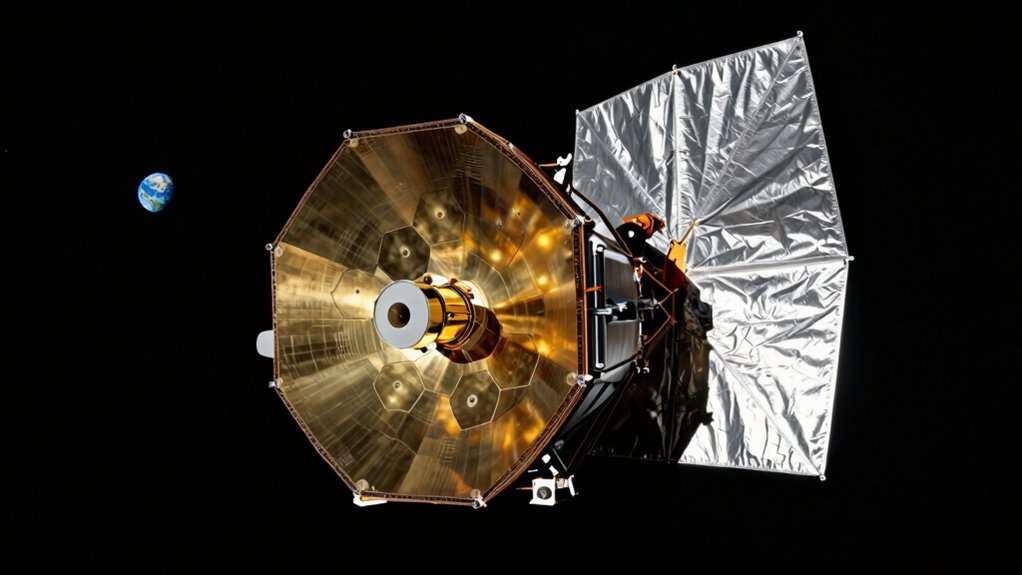
You’re wondering what replaces Hubble, and that’s a smart question. Here’s the thing: no single telescope fills every role. Webb excels in infrared, seeing early galaxies, while Hubble still dominates visible light. Roman will scan huge sky areas but lacks Hubble’s flexibility. You need a whole fleet, not just one successor, to cover all cosmic wavelengths. Stick around to see exactly how these specialized instruments work together.
Is JWST Replacing the Hubble Space Telescope?
So, you’re wondering if the James Webb Space Telescope is actually replacing Hubble? You’ve heard the headlines, but they’re misleading you. NASA explicitly calls Webb a successor, not a direct replacement for the aging icon.
Here’s the thing: Hubble still dominates visible and ultraviolet light observations today. Webb focuses entirely on infrared wavelengths that Hubble simply cannot see. You need both telescopes working as a team to get the full cosmic picture. Just as amateur astronomers must select optics based on light gathering power to match their viewing goals, scientists rely on these distinct instruments to cover the full electromagnetic spectrum.
Don’t think JWST capabilities make Hubble obsolete overnight. That old workhorse keeps delivering unique science decades after its launch. Its Hubble legacy remains crucial because no other telescope covers those specific light spectra.
Obviously, calling Webb the “new Hubble” is just lazy media shorthand. You should understand they complement each other rather than swap roles directly. Hubble continues its mission while Webb expands our view into the infrared universe. Understanding how different instruments capture specific light spectra is essential for choosing the right telescope for your astronomical goals. When evaluating options, stargazers must weigh factors like optical performance alongside cost to find the instrument that best suits their specific needs.
Why JWST Succeeds Hubble in Infrared Astronomy
You’re right to wonder why infrared matters so much for seeing the early universe. Light from those first galaxies stretches into infrared as space expands. Hubble misses most of this signal because it focuses on visible light.
JWST’s massive mirror gathers nine times more light than Hubble does. This power lets you spot objects just 200 million years after the Big Bang. Its specialized infrared capabilities pierce through dust clouds that hide stellar nurseries from visible telescopes.
Now, you can study cool, distant worlds previously invisible to us. The telescope detects faint molecular signatures in exoplanet atmospheres with stunning clarity. Obviously, this sensitivity reveals details about planetary systems forming right now.
You gain a direct window into cosmic dawn that Hubble simply cannot provide. This shift defines why Webb succeeds where Hubble reaches its limits. Just as selecting the right instrument depends on optics and performance, each telescope excels in specific wavelengths rather than replacing the other entirely. Expert observers know that thermal stability is also critical for maintaining the precise alignment needed for deep-space infrared imaging. Understanding how different mirror coatings reflect specific wavelengths helps explain why Webb is optimized for infrared while Hubble dominates visible and ultraviolet spectra. Next, let’s explore where Hubble still beats Webb in visible light.
How Hubble Still Outperforms Webb in Visible Light
Although Webb’s mirror is huge, it doesn’t beat Hubble at visible light. You might think bigger always means sharper, but wavelength matters too. Webb sees red and orange best, missing the blue spectrum entirely.
Hubble’s advantages shine because it targets the full visible light range directly. Its instruments capture wavelengths from 200 nanometers up to 2.4 microns perfectly. You get images matching human vision, not just infrared translations. Webb’s 6.5-meter mirror gathers more light, yet Hubble’s optical design delivers crisper results here. Sharpness depends on matching the mirror to shorter wavelengths. This is because optical resolution relies heavily on the ratio between the telescope’s diameter and the specific wavelength of light being observed. Achieving this clarity requires precise light gathering capabilities tailored to the specific part of the spectrum being studied. When evaluating telescope optics, the specific design determines how effectively different wavelengths are focused for clear observation.
Will the Roman Telescope Replace Hubble’s Wide Field?
You might wonder if Roman simply takes over Hubble’s wide-field job entirely. It doesn’t replace every function, but it crushes specific survey tasks. Roman advantages include a field of view one hundred times larger than Hubble’s.
Here’s the thing: Hubble limitations stem from its narrow focus on single targets. Roman scans huge sky areas quickly, acting like one hundred Hubbles combined. You get Hubble-like resolution across vast distances in near-infrared light instantly. Scheduled to launch in late 2026, this capability will redefine how we map the cosmos.
Obviously, this trade-off means less flexibility for unique, pointed observations later. Roman excels at statistical surveys, not general-purpose astronomy duties. You gain massive data speed but lose some versatile targeting options. Even with such powerful space instruments, successful observation still depends on finding dark sky conditions free from light pollution to maximize clarity. Just as ground-based stargazers must seek out minimal light pollution to see faint objects clearly, space survey data relies on pristine conditions to uncover the universe’s deepest secrets. While space telescopes avoid atmospheric interference, amateur astronomers selecting equipment must carefully consider their optical design to match specific viewing goals.
What Future Missions Aim to Restore UV Capabilities?
Since Hubble’s unique UV eyes will eventually close, you’re probably wondering who picks up the slack. NASA’s UVEX launches in 2030 to bridge this gap with sensitive observations. It won’t match Hubble’s sharpness, but it keeps data flowing until bigger things arrive.
The Habitable Worlds Observatory stands as the true long-term successor for restoring capabilities fully. This flagship mission enters design now to eventually dominate the UV-visible spectrum again. Other future missions like CASTOR and ULTRASAT target specific niches like transient tracking. They offer wide fields or near-UV imaging rather than perfect Hubble clones.
Concepts like CETUS once promised deep far-UV spectroscopy down to 1000 angstroms. While not all proposed telescopes fly, the collective effort guarantees no total blackout occurs. You get a coordinated fleet instead of a single fragile replacement waiting in line. Unlike consumer models where you must focus on choosing the right telescope for your budget, these space-based assets are selected for their specific scientific gaps.
Restoring these essential views takes many specialized tools working together over decades. By using plain language to describe these complex mechanics, we can better understand how this coordinated fleet maintains our view of the ultraviolet universe.
Why Multiple Telescopes Are Needed to Replace Hubble
When you hear “Hubble’s replacement,” you might picture one giant telescope taking over every job, but that’s not how it works. You actually need a whole fleet because no single instrument covers Hubble’s entire wavelength range. Webb sees infrared light only, while Hubble mastered visible and ultraviolet views.
Here’s the thing: different wavelengths reveal totally different cosmic secrets. Infrared peers through dust, but ultraviolet tracks hot stars. You lose critical data if you rely on just one scope. That’s why NASA builds a portfolio for true observational diversity instead of one universal machine.
Obviously, engineering one telescope to do everything forces impossible tradeoffs in cost and design. You get better science by splitting missions like Roman and Webb. Each solves specific problems without compromising the others. So, you shouldn’t look for a single successor. Instead, watch how these specialized tools work together to paint the full picture. What specific mystery do you want them to solve next? Selecting the right instrument depends on understanding optical design to match the telescope’s capabilities with your specific scientific goals. Just as professional observatories require specific configurations for distinct wavelengths, amateur astronomers must consider aperture size to ensure their chosen telescope gathers enough light for their target objects. Different optical systems, such as reflector telescopes, offer distinct advantages in light gathering and image clarity that influence which missions are built for specific spectral ranges.