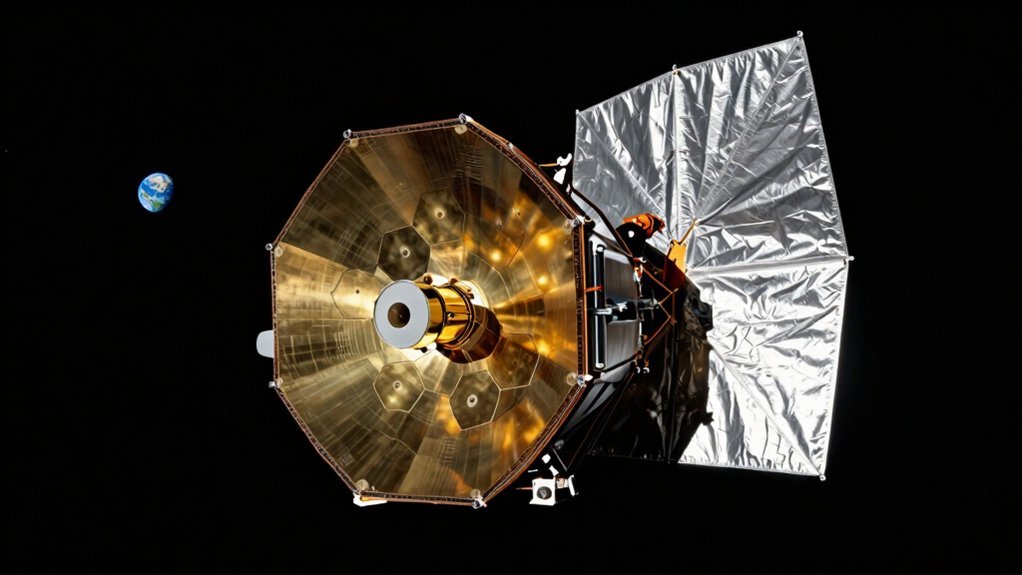
You’re wondering how Hubble discloses our galaxy’s hidden barred spiral and chaotic heart. It cuts through cosmic dust to show a 100,000-light-year disk with a massive central bar. You sit 26,000 light-years away in the Orion Arm, safe from the crowded center’s four-million-sun black hole. Hubble’s sharp infrared eyes map half a million hidden stars, tracing 13 billion years of violent mergers. Keep exploring to reveal exactly how these ancient collisions shaped your cosmic home.
What Is the Milky Way’s Barred Spiral Structure?
You’re probably wondering why astronomers call our home a “barred” spiral instead of just a regular one. It’s because a massive, peanut-shaped bar of stars cuts right through the center. This distinct structure defines our galaxy’s barred classification and drives the whole show.
Now, look at those sweeping spiral arms extending outward from the bar’s ends. They contain young stars and gas, winding loosely across the vast disk. Infrared surveys proved this bar exists by counting stars hidden behind cosmic dust.
Here’s the thing: that central bar stretches roughly 27,000 light-years long. It holds up to forty percent of the bulge’s stellar mass. Obviously, this shape influences how gas flows and stars move throughout the system. Just as selecting the right telescope types depends on your specific stargazing goals, understanding this central bar is key to grasping the dynamic evolution of our galaxy. For those eager to observe such deep-sky structures, mastering optical alignment ensures the clearest possible view of faint galactic features. Since telescopes rely on light gathering to reveal dim objects, this same principle allows astronomers to detect the faint stellar populations that make up the galaxy’s extensive bar.
Where Does Our Solar System Sit in the Galaxy?
That massive bar shapes everything, but you’re probably wondering where we actually fit in this grand design. You reside in the Orion Arm, a minor spur between major spiral structures. Your Solar Position sits roughly 26,000 light-years from the chaotic Galactic Center.
You aren’t buried in high Stellar Density regions near the core either. Instead, you occupy a quiet neighborhood halfway to the galaxy’s outer edge. This spot offers safety from intense radiation while keeping stars close enough to see. You orbit the center every 250 million years at speeds hitting 270 km/s. Selecting the right optical system ensures astronomers can distinguish these faint structural details from our vantage point within the disk. A telescope with a larger aperture size collects more photons, revealing the subtle density variations of our local arm against the dark sky.
Obviously, this location matters because it keeps our system stable and safe. You enjoy a calm view unlike those crowded central zones. Now you know exactly where home sits within our vast spiral disk. Understanding how light gathering works helps astronomers observe these distant structures clearly despite our vantage point. Next, let’s compare our galaxy’s sheer size against its cosmic neighbors.
How Large Is the Milky Way Compared to Others?
How does our home stack up against the cosmic heavyweights? You might think we’re huge, but let’s check the size comparison. Our disk spans roughly 100,000 light-years, yet Andromeda stretches wider at 220,000. Giant ellipticals like IC 1101 dwarf us completely, reaching millions of light-years across.
Here’s the thing: galaxy rankings place us firmly in the middle. We beat tiny dwarf galaxies easily, but we’re slightly undersized compared to similar spirals. You’re living in an average barred spiral, not a cosmic monster. Obviously, 400 billion stars still feel massive to us humans. Understanding the optical limits of your equipment is crucial when trying to resolve the faint details of such vast structures from Earth. Since light gathering power depends on aperture size, selecting a telescope with a larger aperture allows you to capture more photons from these distant, dim galactic features. Different telescope designs offer varying levels of light gathering power, so choosing the right type is essential for observing faint deep-sky objects effectively.
What Hides at the Galaxy’s Crowded Heart?
Ever wonder what’s actually hiding behind all that cosmic dust at the center? You’d encounter Sagittarius A*, a supermassive black hole weighing four million suns. It dominates the region, pulling stars into wild orbits you can’t see with visible light.
Now, imagine packing a million suns into a space smaller than our nearest star neighbor. That’s the crowded nuclear cluster Hubble reveals using infrared eyes. These hidden phenomena create chaotic core dynamics where gas clouds collapse into new stars constantly.
Here’s the thing: magnetic filaments and strange arcs swirl around this dense bulge. You need radio waves to spot these exotic structures blocking our normal view. The center acts as a unique lab for extreme physics you won’t find elsewhere.
Obviously, this chaotic heart holds secrets about how galaxies truly evolve over time. While Hubble excels at revealing these infrared details, choosing the right instrument requires comparing telescope optics to match specific stargazing goals. Understanding the differences between reflector and refractor designs is essential before investing in your own equipment to explore the night sky. Different optical systems offer distinct advantages regarding light gathering power and image clarity depending on your observation targets. Next, you’ll learn why seeing the whole galaxy clearly remains such a tough challenge.
Why Can’t We See the Whole Galaxy Clearly?
Why does the Milky Way look like a blurry band instead of a crisp spiral? You sit inside the disk, viewing our home edge-on rather than from above. This limited viewpoint creates significant observational challenges for mapping the full structure.
Interstellar dust blocks visible light, causing obscured visibility across distant spiral arms. Dense clouds absorb photons, hiding the far side from your optical telescopes. Bright foreground stars crowd the view, making faint background objects impossible to separate clearly.
Light pollution further dims the sky for one-third of humanity today. You cannot capture a single complete image because you are trapped within the system. Astronomers must stitch many mosaics together to reconstruct the hidden galactic map.
You need different wavelengths to pierce these thick cosmic veils effectively. How do scientists see through such dense obstacles? The region heavily blocked by this dust is historically known as the zone of avoidance. Overcoming these barriers required the development of a revolutionary telescope capable of observing beyond the limitations of visible light. Understanding how light gathering power works helps explain why larger instruments are essential for detecting faint structures through such obscuration. Selecting a device with superior optical performance ensures that even the faintest details behind cosmic dust can be resolved with greater clarity.
How Does Hubble See Through Thick Cosmic Dust?
So how does Hubble actually pierce that thick cosmic fog? You might think dust blocks everything, but obviously, it doesn’t stop all light. Hubble uses near infrared imaging to catch longer waves that slip right through those tiny grains.
Here’s the thing: visible light scatters easily, while infrared radiation travels deeper into dusty nurseries. This dust penetration lets you spot warm protostars hidden inside dense molecular clouds. You see the cloud become semi-transparent, revealing baby stars previously masked by opacity.
Now, Hubble’s 2.4-meter mirror gives sharp views above Earth’s atmosphere, yet limits exist. It works best when you combine its data with other telescopes for full context. You get clearer structures, not total removal of the obscuring material. For optimal results, experts recommend planning your observations during moonless nights to minimize sky brightness and enhance contrast. While Hubble excels at optical and ultraviolet views, selecting the right telescope type is crucial for matching specific scientific goals and budget constraints.
The takeaway? Infrared tools reveal hidden domains, but multi-wavelength strategies yield the truest maps. Next, you’ll wonder what specific treasures Hubble found lurking in those central clusters.
Understanding how light wavelengths behave differently allows astronomers to select the right telescope for penetrating specific cosmic barriers.
What Did Hubble Find in the Central Star Cluster?
You’ve probably wondered what hides inside those crowded cores where ground telescopes just see a blur. Hubble resolved 30,000 distinct stars within just 22 light-years, proving these centers aren’t uniform blobs. You now see how gravity drives intense star cluster dynamics right before your eyes.
Here’s the thing: heavier stars sink while lighter ones bounce outward like billiard balls. This mass sorting creates deep implosions, hinting at hidden intermediate-mass black holes weighing 800 suns. Obviously, these Hubble findings rewrite our understanding of such ancient, dense stellar cities.
You realize these clusters hold multiple stellar generations formed rapidly billions of years ago. Gravity reshapes everything dynamically rather than leaving structures static and boring. Now you grasp why central regions pulse with such chaotic, compact energy.
Your next step involves asking how these violent histories shaped our entire galaxy’s evolution over time. For those seeking similar clarity in their own observations, mastering optical alignment is essential to resolving fine details in crowded fields. Just as precise equipment setup reveals hidden cosmic structures, understanding telescope collimation ensures your optics deliver the sharpest possible view of dense star fields.
How Did the Milky Way Evolve Over Billions of Years?
Since you’re wondering how our home grew from tiny seeds, let’s trace that 13-billion-year journey. You see, cosmic dawn sparked early galaxies and star clusters that built our foundation. Hierarchical assembly drove this massive galaxy growth through countless galactic mergers over billions of years.
Now, intense star formation shaped the thick disk shortly after the Big Bang began. Gas rich disk structures later emerged, creating the familiar spiral arms you observe today. These processes defined the current Milky Way structure while cosmic evolution continued relentlessly.
Here’s the thing: major collisions like Gaia Enceladus altered our path considerably around 11 billion years ago. You can still spot ancient star clusters preserving evidence of those chaotic early times. Obviously, our galaxy isn’t finished evolving yet as future collisions await us all.
This long history explains why our cosmic neighborhood looks exactly how it does right now.
Why Is Hubble Essential for Mapping Our Galaxy?
Why does Hubble matter so much when you’re trying to map our crowded galaxy? You need sharp eyes because ground telescopes blur together tightly packed stars. Hubble’s role provides images five to twenty times sharper, separating individual lights in the dense core.
Now, consider the dust blocking your view of the Milky Way’s heart. Infrared observations pierce that haze, revealing over half a million hidden stars clearly. This capability transforms how you understand the complex Stellar population within obscured regions.
Here’s the thing: precise brightness measurements let you distinguish star ages accurately across vast distances. Such data fuels reliable Galactic mapping by tracing structures otherwise lost to interstellar extinction. You finally see the true three-dimensional shape of our home.
Obviously, without this space-based clarity, your maps would remain incomplete and fuzzy guesses. Ready to explore how these stars actually move through space next?