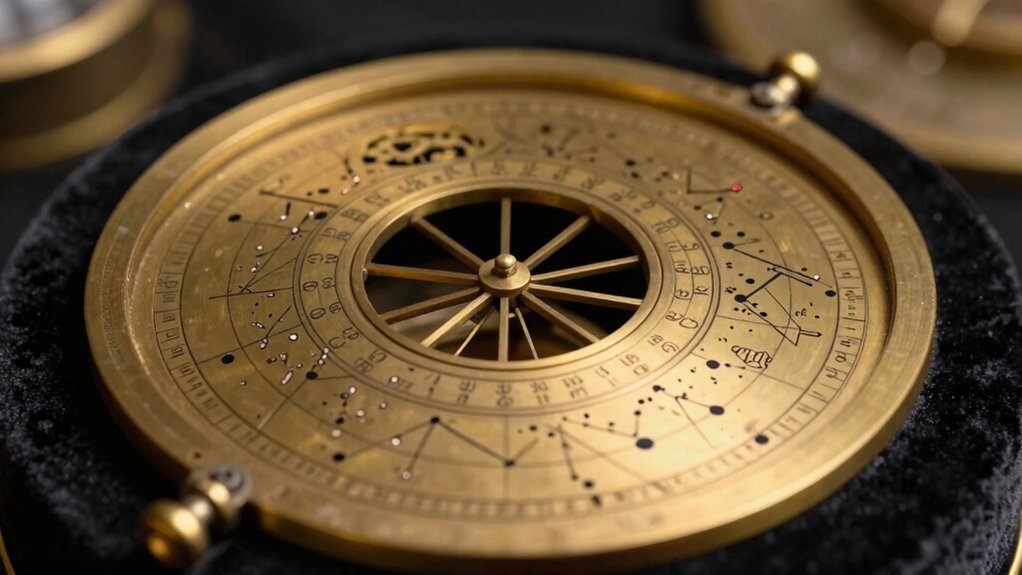
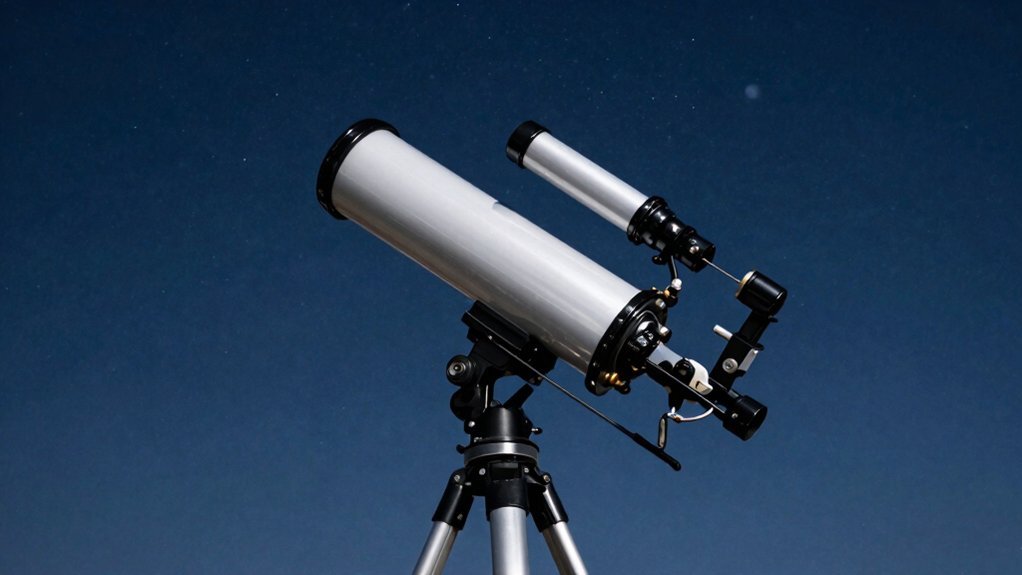
You’re wondering how a 1756 Fleet Street shop became the gold standard for precision telescopes. Edward Troughton and William Simms merged in 1826, combining mastery of dividing engines with expert craftsmanship. They built robust theodolites for surveying and trusted transit telescopes for Greenwich Observatory by 1816. Cooke eventually merged with them in 1922, moving operations to York while preserving their legacy. Uncover exactly where surviving instruments rest and how to authenticate them next.
How Did Troughton and Simms Start in London?
If you’re wondering how this famous firm actually began, you’ve hit on a story that starts way before the name Troughton & Simms ever existed. You’ll find its true London origins in 1756, when John Troughton Senior opened his first shop after training with Thomas Heath. This family business grew steadily along Fleet Street for decades, creating a solid foundation long before any partnership formed. The firm’s early success was driven by their mastery of dividing engines, which allowed for unprecedented accuracy in marking instrument scales.
Now, consider the instrument evolution happening there. Edward Troughton expanded this trade considerably, focusing on precision astronomy and surveying tools that scientists desperately needed worldwide. He didn’t start from scratch; he inherited a thriving legacy rooted deeply in skilled craftsmanship and local demand. Understanding the specific optical designs used in these early instruments reveals why they remained superior for astronomical observation compared to contemporary options.
Here’s the thing: the 1826 partnership with William Simms simply formalized an already powerful operation. You see, the real story isn’t just about two names joining forces. It’s about generations of perfecting mathematical instruments in one specific city. Keep this timeline clear as you explore who actually built this legacy next. The firm’s reputation was further cemented by their critical contributions to major astronomical discoveries that defined the era of scientific exploration.
Who Were the Founders of This Precision Firm?
So, who actually built this legendary precision firm from the ground up? You need to meet Edward Troughton and William Simms. These two men established the business in London back in 1826.
Troughton brought decades of family workshop tradition and immense reputation to the table. Simms, meanwhile, arrived as an accomplished craftsman with his own successful shop already running. Their founder backgrounds created a perfect storm of technical skill and commercial savvy.
The partnership dynamics shifted when aging Troughton invited Simms to join due to declining health. This wasn’t a fresh start-up but a merging of existing expertise for stability. You see, Troughton’s fame combined with Simms’s energy secured their place in history.
Simms continued leading the firm alone after Troughton died in 1835. Their names survived even the 1922 merger into Cooke, Troughton & Simms. Now you know exactly who shaped this precision legacy from the beginning. Understanding how optical precision impacts performance helps appreciate why their instruments remain historically significant today. Just as modern stargazers must weigh factors like optics and performance when choosing equipment, the firm’s success relied on balancing these same critical elements in every instrument they produced. Selecting the right instrument requires careful consideration of aperture size to ensure optimal light gathering for detailed observation.
What Astronomical and Surveying Instruments Did They Build?
Since you’re wondering exactly what tools came out of their London workshop, let’s clear that up right now. You’ll find various telescope types, including massive 8-inch equatorials for Melbourne and precise 6-inch refractors for Sydney. They built sturdy transit instruments specifically for tracking stars crossing the meridian with incredible accuracy.
Now, consider their essential surveying applications. You’d see their 18-inch altazimuths mapping Victoria while robust theodolites measured land boundaries on Earth. They even crafted double-framed sextants that helped sailors calculate latitude and longitude at sea for decades.
Here’s the thing: their gear served both astronomers and surveyors equally well because precision mattered most. You can trust that every circle division and lens grinding met the highest global standards of that era. This diverse inventory proves they dominated the scientific instrument market completely. Unlike modern hobbyists who must weigh options when choosing the right telescope, their clients received custom-built solutions tailored to specific scientific goals. Modern buyers often struggle to compare optics and performance across different models, whereas Troughton & Simms delivered unified excellence in every commission. Understanding these historical telescope options highlights the specialized nature of their commissions compared to today’s general market. Next, you might ask why Greenwich specifically trusted their complex telescopes above all others.
Why Did Greenwich Observatory Trust Their Telescopes?
You’re probably wondering why Greenwich picked Troughton & Simms over other London makers. Edward Troughton actually built a transit telescope for them in 1816, so trust started early. Their finely divided circles and accurate mountings matched the observatory’s strict needs perfectly.
Here’s the thing: you need real instrument reliability when measuring the Moon near new moon. These telescopes handled solar glare while timing meridian crossings with exact precision. Greenwich confidence grew because five reversible transits worked steadily from 1881 to 1926.
Now, consider that Transit B became the preferred tool for decades of time determinations. Clock errors depended entirely on these repeatable results to set national standards. Obviously, long-term stability matters more than flashy optics for such critical work. Effective telescope use relies heavily on stable mounting systems to prevent vibration from ruining precise measurements.
Their craftsmanship turned raw observation into trusted global time standards. You can see why familiarity and performance kept them in service so long. Just as beginners learn that observing tips improve visibility, surveyors applied this same precision elsewhere. This dedication to accuracy mirrors how modern enthusiasts rely on expert-backed guidance to select the right equipment for their own astronomical journeys.
How Did the Ordnance Survey Use Their Theodolites?
How exactly did surveyors map all of Britain without measuring every single distance? You’d think they measured miles, but they didn’t. Instead, you relied on clever triangulation techniques to connect distant hills.
Now, picture yourself atop a steeple with a Troughton and Simms theodolite. You measured horizontal angles between stations, not long ground distances. These specific theodolite applications let you build a massive network of triangles. By sighting targets through cross-hairs, you recorded angles down to mere seconds of arc.
All right, so how did this actually work in the field? You set up stable tripods on high points like towers or steeples. This gave you clear views for linking principal triangles across the landscape. Your precise angle measurements created the fixed framework for every national map produced later.
Obviously, this method saved immense time compared to chaining every mile. You established geodetic control that lasted for generations of mapping work.
When Did Cooke Merge With Troughton and Simms?
When exactly did these two giants join forces? You might wonder about the specific year they combined. They merged in 1922 to form Cooke, Troughton & Simms. This new firm operated out of York, not London.
Now, consider why this matters for your research. The merger benefits included uniting strong reputations in optical engineering. Troughton & Simms had existed since 1826, while Cooke started in 1837. Their combination created a major British instrument maker during depressed business times.
Here’s the thing regarding historical significance: this event linked two long-established telescope makers. Vickers already controlled Cooke since 1915 before this specific union. The combined company later became a wholly owned Vickers subsidiary in 1924. This consolidation ensured the continuation of revolutionary telescope innovations that defined the era’s astronomical advancements. You now know the precise date and location of this pivotal change. This clarity helps you understand the timeline before tracking down surviving pieces. Understanding this lineage is crucial when choosing the right telescope for historical collections or modern stargazing needs. Where should you look next for these historic instruments? Different telescope types offer unique optical characteristics that reflect the specific engineering strengths inherited from these historic firms.
Where Can Collectors Find Surviving Troughton Telescopes?
Where exactly do you hunt for these rare survivors? You’ll often find them in major museums like the National Maritime Museum, which holds three specific transits from 1870. Obviously, institutional transfers complicate things, as instruments moved between observatories before settling.
Check Australian collections too, since the Powerhouse Museum keeps a stunning 6-inch refractor built between 1875 and 1877. Museums Victoria also displays an 8-inch transit originally costing 1,400 pounds. These surviving examples prove that heritage sites often hide better treasures than formal galleries do.
Use your collector resources to track engravings reading “Troughton & Simms London” on British college instruments. Stonyhurst College and Hospitalfield still retain historic scopes from the mid-1800s within their towers. You must verify provenance carefully because many pieces traveled globally before resting.
Focus your search on documented institutional holdings rather than private auctions for now. Understanding the optical principles behind these historic designs can further assist in identifying authentic pieces before you learn how to authenticate those specific maker marks next. Knowing how light gathering capabilities vary by aperture size helps distinguish between standard surveying tools and high-end astronomical instruments from this era.