You’re wondering if you can spot Jupiter without gear, and you absolutely can. It shines as a steady, cream-white beacon brighter than any star, never twinkling even in city lights. Just step outside after sunset, let your eyes adjust for twenty minutes, and look east for that brilliant dot. While you’ll miss its storms, grabbing binoculars next reveals its moons and disk instantly. Stick around to uncover exactly when and where to catch this cosmic show.
Can You See Jupiter Without a Telescope?
Ever wonder if you really need expensive gear to spot Jupiter? You definitely don’t. Jupiter ranks among the brightest objects in our night sky, making naked eye visibility completely possible for you. You see it as a steady, yellowish-white dot that refuses to twinkle like distant stars do.
Obviously, you won’t spot cloud bands or moons without optical aid. Your unaided vision only captures a bright point of light, not a detailed disk. Yet, finding this giant remains easy even from some light-polluted areas if skies stay clear. You just need to let your eyes adapt to darkness for twenty minutes first.
Here’s the thing: Jupiter is one of five bright planets you can always find. You simply look near the ecliptic path where planets travel across the heavens. Use a star chart app to confirm its exact location tonight. Complete alignment provides optimal viewing conditions tonight as Jupiter aligns with Earth and the Sun. To get the best view, ensure you have clear skies free from heavy cloud cover. For the most successful observation, try to find a location with minimal light pollution to enhance the contrast of the planet against the dark background. Patience allows your pupils to dilate fully for maximum light gathering. Now go outside and find that steady beacon shining above you immediately.
When Is the Best Time to Spot Jupiter?
You’ve found the planet, but you’re probably wondering when it actually looks its best. Timing matters immensely here. Opposition timing marks your golden window, occurring roughly every thirteen months. During this period, Earth sits directly between Jupiter and the Sun. The giant planet shines brightest and stays visible all night long.
Now, consider your specific viewing hour. Late evening offers clearer skies as Jupiter climbs higher. Aim for local midnight when the planet reaches its peak altitude. Higher elevation means less atmospheric distortion blocking your view. These visibility tips guarantee you dodge horizon haze effectively.
Seasons shift these ideal dates slightly each year. January or December often host these spectacular displays depending on the cycle. Clear, steady air beats a perfectly dark sky any day. You don’t need total darkness since Jupiter outshines city lights easily. Wait until full nightfall for the sharpest image possible. Start planning your next clear night out immediately. Additionally, understanding light pollution levels helps you determine if your local urban environment will still allow for a successful sighting. Remember that moon phases also significantly impact sky brightness and contrast, so checking a lunar calendar can help you pick the darkest possible nights for observation. While the naked eye can spot the planet, selecting the right telescope type can reveal intricate details like cloud bands and moons that are otherwise invisible.
Where Should You Look to Find Jupiter?
Where exactly do you point your eyes to spot that bright dot? You’ll find Jupiter traveling along the ecliptic path, just like the Sun and Moon. Scan east after sunset or look south when it climbs higher, roughly three fists up. Obviously, knowing this specific trajectory saves you from randomly searching the entire dark sky. In Northern California, you should specifically search in the southern part of the sky for optimal visibility.
Which landmarks help you confirm you’ve found the right object? Check near zodiac constellations like Aries or Taurus, since Jupiter hangs out there. Use these viewing tips: find a dark spot away from city lights to boost contrast. If you see a steady, super-bright light beating the stars, you’ve likely got it. Allowing your eyes to adjust to the darkness for at least 20 minutes will significantly improve your ability to distinguish the planet’s steady glow from twinkling stars. Understanding how light pollution affects contrast is essential for selecting the best viewing location away from urban centers. Telescopes utilize optical aperture to gather significantly more light than the human eye, revealing details on the planet that remain invisible to naked-eye observers.
Now grab a sky map app to match tonight’s exact position against the ecliptic. This simple step guarantees you aren’t mistaking a bright star for the giant planet. Ready to verify what that steady light actually looks like up close?
What Does Jupiter Look Like to the Naked Eye?
Since you’re wondering if that steady glow is actually the giant planet, you’ve asked the perfect question. You’ll spot Jupiter as a brilliant, cream-white beacon outshining almost every star above. Its intense light often cuts through city glow, making it impossible to miss on clear nights.
Notice how the light refuses to twinkle like distant stars do? That planetary steadiness proves you’re looking at a nearby world, not a far-off sun. While stars shimmer wildly, Jupiter holds firm with a sharp, pearly radiance that feels unusually solid. This lack of twinkling occurs because the planet’s angular diameter is large enough to average out the atmospheric turbulence that causes stars to flicker.
You won’t see any cloud bands or red spots without help, just a tiny, luminous disk. Jupiter’s brightness tricks your eye into thinking it’s a super-star, but that steady shine gives it away. Look for that non-twinkling pearl tonight to confirm your sighting immediately. To get the best view of this steady beacon, ensure you are observing under clear night skies away from heavy light pollution. Starting your observation session by allowing your eyes to adjust to the dark adaptation process will significantly improve your ability to distinguish planetary details from background noise.
What Weather Conditions Help You See Jupiter?
If you’ve been squinting at a hazy sky wondering why Jupiter keeps disappearing, you’re asking the right question. Clouds block your view completely, while smoke or dust washes out that bright dot. You need clear, cloudless nights for the best Jupiter visibility.
Now, consider atmospheric conditions. Turbulent air makes stars twinkle wildly and blurs planetary details. Wait twenty minutes for the air to settle before you look up. Obviously, dry winter nights beat humid summer evenings every time.
Aim high, too. Jupiter shines brightest when it sits twenty degrees above the horizon. Lower views suffer from thick air and rooftop obstructions. Dark skies away from city lights help you spot it easily.
Your takeaway? Chase clear, steady, and dry weather for success. Additionally, monitoring the local weather forecast ensures you pick a night with minimal atmospheric interference. Understanding how optical performance varies with atmospheric stability can further enhance your viewing experience. Keeping an eye on moon phases is also crucial, as a bright moon can wash out the contrast needed to see planetary details clearly. Next, let’s explore why this giant outshines every star in the night sky.
Why Does Jupiter Shine Brighter Than Stars?
You just learned that clear skies help, but you’re still wondering why Jupiter beats every star in brightness. Here’s the thing: stars make their own light, while Jupiter simply reflects sunlight like a giant mirror.
Obviously, size matters here. Jupiter is huge, offering a massive surface for sunlight to hit and bounce back to your eyes. Its cloudy atmosphere boosts this effect substantially. Ammonia crystals scatter light efficiently, creating that intense glow you see without any equipment.
These key brightness factors include its high albedo of 0.52, meaning it reflects over half the sun’s rays. Planetary reflectivity combined with proximity makes it shine brighter than distant, self-luminous stars. When Jupiter nears Earth during opposition, it looks even more spectacular against the dark sky. Historical records show that pivotal telescope events have since allowed us to study the cloud bands and moons that create this reflected brilliance. While naked-eye viewing reveals this intense glow, choosing the right optical performance in a telescope can uncover far more detail than unaided vision allows. Understanding how light gathering works explains why larger apertures reveal fainter details beyond what the human eye can perceive.
You now understand why this gas giant outshines stellar neighbors. Next, you might ask what specific details remain hidden from your naked eye.
What Details Miss Without a Telescope?
Two big details vanish the moment you look up: surface bands and those four famous moons. You see only a bright, steady point of light, not a detailed disk. Obviously, your eyes can’t resolve those fine cloud patterns or separate the glowing moons from the planet’s glare.
Here’s the thing: naked-eye viewing hides all specific Jupiter features like the Great Red Spot or storm systems. You miss the distinct North and South Equatorial Belts entirely because they blend into one shiny dot. Even huge storms stay invisible without magnification, no matter how dark your sky gets tonight.
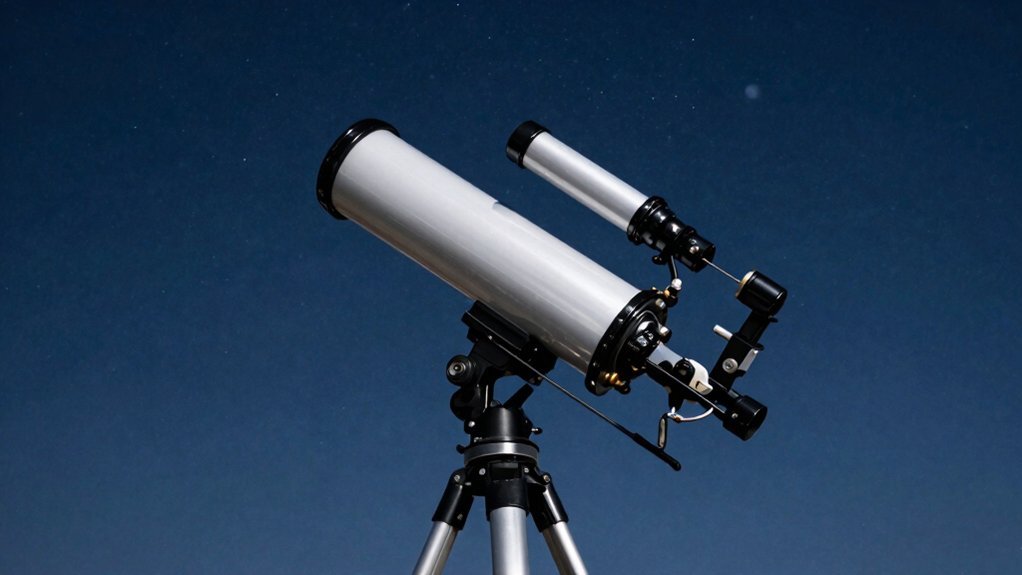
Now, consider the Telescopic advantages that reveal what you currently miss. A small scope instantly splits those hidden moons and shows swirling atmospheric structures clearly. You gain real depth instead of just a bright star-like speck competing with distant suns.
You need optics to see weather, not just light. Grab binoculars next to expose those hidden layers immediately. Understanding optical resolution explains why your unaided eye cannot distinguish these planetary details regardless of sky darkness. Selecting the right telescope aperture ensures you gather enough light to make these faint features visible against the night sky.
How Do Binoculars Change the Viewing Experience?
Three simple upgrades transform that steady dot into a tiny, distinct disk. You finally see Jupiter as a small white circle, not just a star. This shift highlights key binocular advantages over your naked eyes alone.
Now, grab 7×50 or 10×50 models to spot those four Galilean moons easily. They line up like tiny stars near the planet’s bright glare. You might even catch faint cloud bands if the air stays still.
Here’s the thing: shaking hands blur those fine details quickly. Stability importance cannot be overstated when you want a sharp view. Brace your elbows or mount them on a tripod for best results.
Obviously, proper focus turns a fuzzy glow into a defined sphere. Let your optics cool outside for twenty minutes before looking up. You will notice the difference immediately in image clarity and brightness.
Start with steady support to reveal these hidden planetary details today.
What Mistakes Prevent You From Seeing Jupiter?
Even when you’ve got the right gear, bad timing or skipped steps can still hide Jupiter’s details. You might try observing it too low, where thick atmosphere blurs everything. Obviously, waiting until it reaches its highest point clears up those viewing challenges markedly.
Don’t crank up magnification immediately either. High power often makes the planet look soft and blurry on shaky nights. Start low, then increase slowly until the image breaks down around 50x per inch.
Your telescope needs time to cool down outside, or internal air currents will ruin your observation techniques. Also, check your collimation regularly because misaligned optics wash out those famous belts. Finally, accept that poor atmospheric seeing creates turbulence no telescope can fix. Patience yields the best moments of clarity. Now, are you ready to spot those specific cloud bands? Keep in mind that wind speeds on Jupiter can exceed 360 mph, creating the dynamic atmospheric volatility that makes stable viewing conditions so critical for seeing clear details.