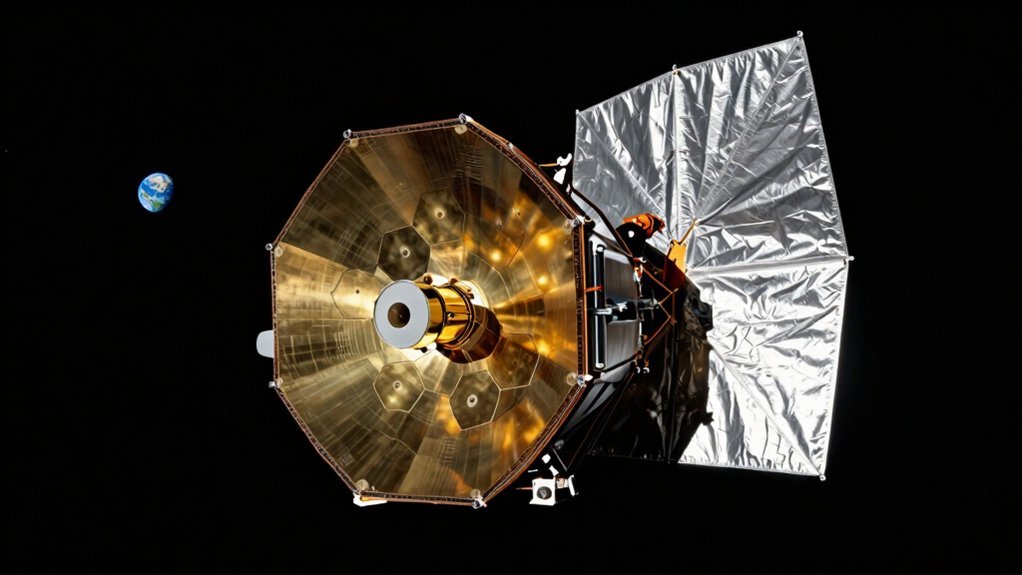
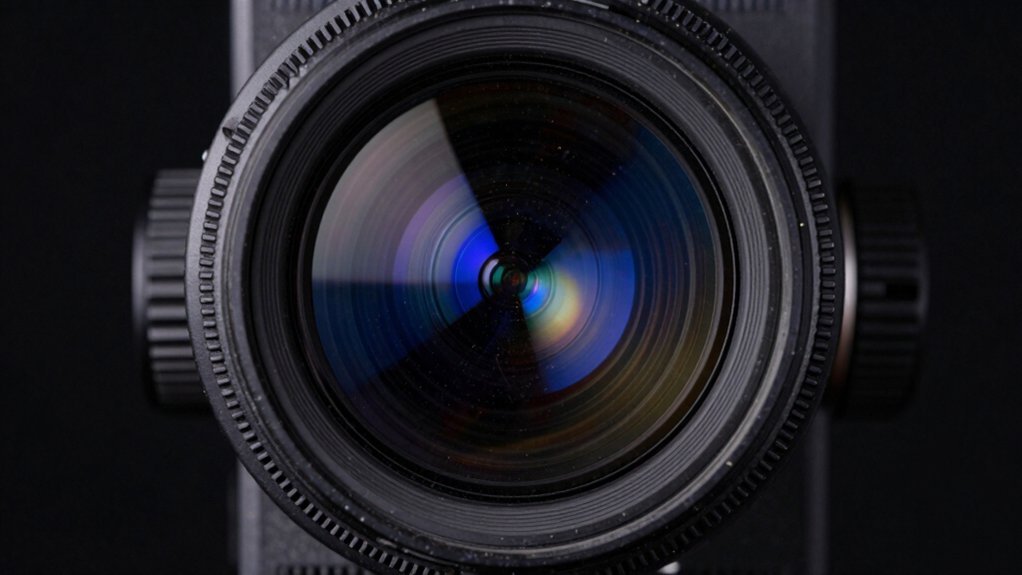
You’re wondering how telescopes catch faint light from billions of years ago, and honestly, it’s all about acting like a giant bucket for photons. Your eyes miss most of this light, but a telescope’s curved mirror gathers it all to a single focus point. Obviously, doubling your aperture size quadruples the light you collect, revealing galaxies that were previously invisible. Now you see why bigger mirrors matter so much for deep space views. Stick around to uncover exactly how space instruments beat atmospheric blur.
How Do Telescopes Gather and Focus Faint Light?
Since you’re wondering how we see faint stars, let’s clear that up right now. Telescopes act like giant buckets catching photons that your eyes miss completely. This light gathering process collects far more energy than your pupil ever could.
Now, consider how that captured glow actually becomes a picture you can study. A curved mirror or lens bends those parallel rays toward a single focus point. This precise bending creates image formation by landing different angles at specific spots. Obviously, without this concentration, you’d just see a vague, washed-out blur in the sky. Different telescope designs utilize specific optical configurations to minimize aberrations and sharpen these focused images for clearer viewing.
Here’s the thing: the primary optic does the heavy lifting before magnification even starts. You need that initial collection to make distant, dim objects detectable at all. Without enough gathered light, no amount of zooming will reveal hidden cosmic details. The effectiveness of this system relies heavily on the aperture size to determine exactly how much light is collected for observation. When evaluating options, the balance between optical performance and cost often dictates which instrument best suits a stargazer’s specific needs.
Why Does Aperture Size Matter for Visibility?
While you might think magnification is king, aperture actually decides what you can see at all. You need serious light collection to spot faint galaxies hiding in the dark sky. A bigger opening grabs considerably more photons than a tiny lens ever could.
Here’s the thing: doubling your aperture diameter quadruples your total light-gathering power instantly. That massive jump reveals dim nebulae that smaller scopes simply miss completely. These aperture advantages mean sharper details on planets too, not just brighter images. You won’t get blurry blobs when pushing magnification higher with a wide mirror.
Obviously, a 200mm scope beats a 100mm one by gathering four times more light. Small lenses work for bright planets, but deep space demands serious width. Your viewing limits expand directly as your primary mirror or lens grows larger. This capability is defined by the limiting magnitude, which determines the faintest object visible based entirely on your telescope’s aperture size. Choose wisely based on what faint objects you really want to explore tonight. Remember that atmospheric turbulence often restricts the maximum useful magnification power regardless of how large your optics become. To get the best views, you must also find a location with minimal light pollution blocking the natural darkness of the night sky. Different optical designs like refractors and reflectors offer unique benefits depending on your specific stargazing goals and budget for telescope options.
How Do Mirrors Outperform Lenses in Modern Designs?
You’ve seen why big apertures matter, but you’re probably wondering why modern giants use mirrors instead of giant glass lenses. Here’s the thing: massive lenses sag under their own weight, distorting your view. Mirrors solve this by staying thin and light while collecting huge amounts of light.
Now, consider image quality. Glass lenses split light into colors, creating fuzzy edges known as chromatic aberration. Mirrors reflect all wavelengths perfectly, avoiding these lens limitations entirely. You get sharper images across infrared and visible spectrums without heavy glass blocks absorbing your signal.
Manufacturing also favors mirror advantages. Polishing one reflective surface beats crafting flawless glass throughout a thick block. You can fold the light path too, making giant telescopes surprisingly compact for launch. Obviously, this design lets engineers build observatories that lenses simply cannot support physically. When evaluating optics performance, it becomes clear that mirror-based systems offer superior scalability and clarity for both amateur and professional stargazers. For those comparing options, understanding cost differences is essential to finding the perfect stargazing match for your budget and goals.
How Can We See Objects Billions of Years Away?
How exactly do you spot something that existed billions of years ago? You catch ancient light traveling across vast light years. Since light moves slowly, you see objects as they were, not as they are now.
Here’s the thing: our expanding universe stretches space while that light travels. This means distant galaxies sit farther away today than when they emitted their photons. You witness cosmic history unfolding because every observation acts like a delayed image from the past.
Now, astronomers use redshift measurement to calculate these extreme distances accurately. As space expands, it stretches light waves, shifting them toward the red end of the spectrum. You need this data because simple geometry fails at such massive scales. Objects not bound by gravity expand away from each other, while expansion is negligible within local groups or galaxies.
Powerful telescopes gather enough faint light to reveal these early universes clearly. You effectively look back over thirteen billion years to see infant galaxies forming. Your view extends deep into time, sampling most of existence itself. To capture these faint signals effectively, many astronomers rely on reflecting telescopes which use mirrors to gather and focus light without the color distortion found in lens-based systems. Just as digital tools help you discover your location instantly, these instruments pinpoint our place in the cosmic timeline by analyzing where and when this ancient light originated. The primary mirror serves as the most critical component in these systems, determining exactly how much light the instrument can collect to form a bright, clear image of such distant targets.
Why Do Space Telescopes Outperform Ground-Based Ones?
Why does Earth’s air ruin your view of the stars? You see twinkling caused by atmospheric distortion, which smears your images. Ground telescopes fight this turbulence, but space scopes capture diffraction-limited sharpness like Hubble’s 0.05 arcsecond resolution. Obviously, leaving the atmosphere grants you crystal-clear vision without blurry interference.
Now, consider wavelength access. Earth’s air blocks ultraviolet and infrared light, hiding huge parts of the spectrum. Space telescopes open these new windows, letting you study invisible cosmic processes directly. You gain continuous observing time too, skipping daylight and weather losses entirely. Ground-based facilities must be situated in dry, transparent locations to maximize visibility through the limited wavelengths that penetrate the atmosphere. To further mitigate atmospheric interference, advanced ground observatories utilize adaptive optics systems to correct distortion in real-time. This technology measures atmospheric turbulence hundreds of times per second to adjust mirror shapes and restore image clarity. Choosing a site with stable air currents is also critical for minimizing natural blurring before electronic corrections even begin.
Your view stays darker above light pollution and airglow, boosting contrast for faint galaxies. While ground scopes offer easier repairs and larger mirrors, space instruments deliver superior data quality. You trade maintenance convenience for unmatched clarity and full spectral coverage. Ultimately, escaping Earth lets you see the universe exactly as it is. Ready to explore how these tools capture ancient light?