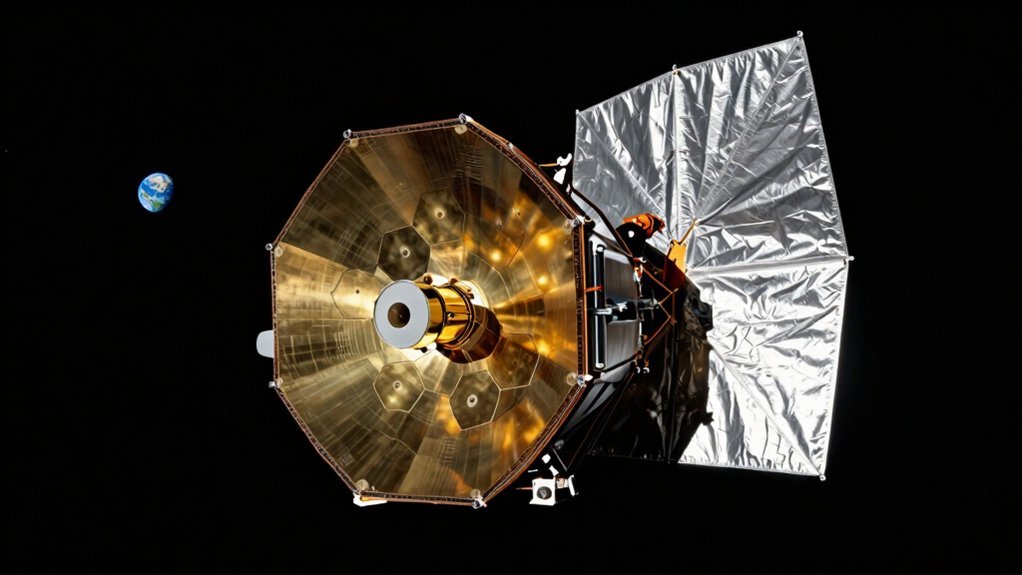
You’re probably wondering if Webb circles Earth like other satellites, but it actually orbits the Sun. It hangs near a gravitational balance point called L2, roughly 1.5 million kilometers away. This spot lets it stay cold while tracking deep space without constant fuel burns. Obviously, that distance keeps heat from ruining its infrared vision. Stick around to see exactly how this unique halo orbit works.
Does the Webb Telescope Orbit Earth or the Sun?
So, you’re wondering if the Webb Telescope circles Earth like Hubble does? You’ve asked exactly the right question because many assume it stays close. Actually, the Webb Telescope orbits the Sun, not our planet. It travels nearly a million miles away.
Here’s the thing: celestial mechanics dictate this unique path. Webb follows Earth around the Sun while hovering near a specific gravitational balance point. This spot keeps the Sun, Earth, and Moon aligned behind its sunshield. Hubble circles us tightly, but Webb drifts far out into space. Just as selecting the right telescope optics is crucial for clear viewing, Webb’s specific orbital design ensures optimal performance for its infrared instruments.
Obviously, this distance prevents any quick repair missions. You need to understand that Webb’s halo orbit maintains stable, cold conditions for infrared science. It doesn’t circle Earth at all. Instead, it locks step with our planet around the star. Effective observation requires minimizing thermal interference, which is why understanding infrared sensitivity is vital for apprecing why Webb operates so far from Earth’s heat.
Now you know Webb belongs to the Sun’s system. This setup protects its sensitive instruments from heat. By maintaining this position, the telescope utilizes gravitational balance to stay fixed relative to Earth without constant fuel consumption. Ready to learn why that specific distant spot matters so much?
What Is the Sun-Earth L2 Lagrange Point?
That distant spot you’re wondering about is the Sun-Earth L2 Lagrange point. It sits 1.5 million kilometers behind Earth, perfectly aligned with the Sun. You might think it’s a physical object, but it’s actually just a special region in space. Joseph-Louis Lagrange predicted this unique location where gravity and motion create a stable equilibrium for spacecraft.
Here’s the thing: L2 characteristics rely on a precise gravitational balance between our star and planet. This setup lets you orbit the Sun at the exact same rate as Earth does. Your telescope stays cold and dark because the Sun, Earth, and Moon remain on one side. Obviously, this spot offers an unobstructed view of deep space without constant temperature swings. Maintaining this position requires active station-keeping to counteract the inherent instability of the Lagrange point. Just as terrestrial observers must ensure their equipment is properly calibrated, space missions depend on thermal stability to function correctly in such extreme environments.
You gain a steady thermal environment perfect for sensitive infrared observations. Now you understand why Webb hangs out there instead of circling Earth directly. For enthusiasts seeking similar clarity in their own stargazing, mastering optical alignment is essential for maximizing view quality. Next, let’s explore how that tricky halo orbit actually keeps everything aligned.
How Does Webb’s Halo Orbit Maintain Alignment?
How exactly does Webb stay put without an anchor? You might think it hovers motionless, but that’s wrong. It actually traces a giant halo loop around the L2 point. This path relies on precise gravitational geometry to keep everything aligned.
Now, here’s the thing: the orbit isn’t naturally stable on its own. You need periodic thruster firings about every 21 days to fix drift. These burns guarantee trajectory stability while Webb orbits the Sun. Think of it like balancing a ball on a hill; you must constantly nudge it. The mission originally projected a lifespan of 5 to 10 years, yet efficiency has extended operations to potentially 20 years. Just as expert stargazers prioritize optical clarity to maximize their viewing sessions, Webb’s precise positioning ensures its instruments remain free from thermal interference.
All right, so the spacecraft completes one wobble roughly every 180 days. This controlled drift keeps Webb facing Earth without blocking its view. You get consistent communication and steady observing conditions thanks to these maneuvers. Remember, this active correction defines the mission’s decade-long lifespan. Understanding the gravitational geometry behind this motion is essential for choosing and using a telescope effectively. Just as selecting the right optical design impacts performance, knowing how orbital mechanics function helps astronomers maximize observation time. Next, let’s explore why this specific spot matters for keeping instruments cold.
Why Is the L2 Location Critical for Thermal Control?
Two massive heat sources, the Sun and Earth, sit behind you at L2, letting a single sunshield block them all. You need this geometry because your instruments must stay extremely cold to catch faint infrared signals without interference.
Now, this setup enables incredible thermal stability by keeping temperature fluctuations minimal during your halo orbit. You avoid Earth’s shadow, which prevents sudden heating or cooling cycles that could warp your structure. Obviously, staying 1.5 million kilometers away reduces Earth’s warm infrared glow greatly too. This specific location allows the gravitational influences of Earth and Sun to balance the centripetal force required for your stable orbit.
Here’s the thing: this arrangement supports efficient passive cooling, so you don’t need heavy refrigeration systems. Your sunshield handles the hard work while solar panels drink uninterrupted sunlight on the hot side. This precise balance lets you observe the universe with unmatched clarity and sensitivity. Just like a beginner learning to identify faint stars requires dark skies free from light pollution, your telescope needs this isolated environment to detect the most distant galaxies. Applying these essential tips ensures your equipment operates at peak performance in such a demanding environment. Mastering the optical alignment of your system is equally vital to maintain image sharpness against the backdrop of deep space.
You now understand why L2 is essential for keeping your telescope frosty and focused. Next, you might wonder exactly how far away you are from Earth right now.
How Far Away Is Webb From Earth Today?
So, where exactly are you right now? You might think Webb sits still, but it actually orbits the Sun near the L2 point. Your current Webb distance averages 1.5 million kilometers, which is roughly one million miles away from Earth. That places you about four times farther out than the Moon ever gets.
Here’s the thing: you don’t stay fixed at one spot because you travel in a large halo orbit. Your position shifts constantly, creating a dynamic range that varies your distance between 1.25 and 1.8 million kilometers daily. Obviously, this movement means your exact mileage changes even though you remain centered near that 1.5 million kilometer mark. You are definitely not orbiting Earth like Hubble does up above. Instead, you circle the Sun while keeping Earth and the Sun behind your massive sunshield. This specific distance keeps you cold enough for serious infrared work. Understanding the thermal stability provided by this location is crucial for maintaining the telescope’s sensitive instruments. Mastering these orbital mechanics ensures the spacecraft maintains its precise alignment without excessive fuel consumption. Now you know exactly how far away you really are today. Following a practical step-by-step walkthrough ensures beginners grasp these orbital mechanics correctly from the start.
What Makes This Orbit Ideal for Infrared Astronomy?
All right, you’re probably wondering why this specific spot matters so much for infrared work. Here’s the thing: the Sun, Earth, and Moon stay on one side, letting the sunshield block their heat permanently. This setup creates a stable, cold environment essential for your infrared sensitivity.
Obviously, thermal management is critical because warm optics emit their own glow, ruining faint cosmic signals. At L2, Earth’s heat barely reaches the telescope, keeping detectors near absolute zero without extra effort. You get minimal stray light and nearly constant lighting conditions for clear viewing.
Now, consider that you can access 100% of the sky over six months as the geometry shifts. The stable gravitational point also means less fuel is needed to maintain this perfect observing angle. Your data stays pure because background radiation stays low.
This orbit simply lets Webb see the universe’s faintest infrared details without interference. Just as expert stargazers seek dark sky conditions to maximize contrast, Webb’s location ensures the ultimate darkness for detecting the faintest cosmic signals. By leveraging this stable thermal environment, astronomers ensure the instruments remain cold enough to detect the faintest heat signatures from the early universe. Next, let’s look at how it communicates with us.