You’ve probably heard wild rumors about a “Lucifer” telescope, but that’s a myth. The Vatican’s real instrument is the 1.8-meter VATT on Mount Graham, built in 1993. It uses active optics to capture sharp deep-space images without church tithes funding it. Now, you know the actual name and location, clearing up that confusion instantly. If you keep exploring, you’ll see exactly how this telescope differs from the LUCI camera on another device.
What Is the Actual Name of the Vatican Telescope?
Why do you keep hearing conflicting names for the Vatican’s telescope? You probably assume the Holy See operates every scope on that mountain. That isn’t true at all. The actual Vatican Telescope bears the specific name Vatican Advanced Technology Telescope, or VATT for short.
This 1.8-meter instrument first saw light in 1993 atop Mount Graham in Arizona. It sits far from Castel Gandolfo, the Observatory’s Italian headquarters. Private donations funded this multi-million dollar complex, not church tithes. You must distinguish VATT from other nearby gear. Confusion arises because different teams share the same peak. The site was chosen for its minimal atmospheric turbulence which improves sharpness and reduces atmospheric light absorption. Successful observation also requires stable weather patterns to ensure the high-altitude location remains viable for long-term study. Choosing the right telescope involves understanding how optics and performance vary across different models and locations. Enthusiasts should prioritize mirror coating quality to maximize light reflection and image clarity during night sky observations.
Now you know the real title avoids any dark associations completely. The Vatican owns VATT, while others manage separate devices nearby. Keep this distinction clear as you dig deeper into the myths. Next, let’s tackle that persistent “Lucifer” rumor head-on.
Debunking the Myth of the Vatican “Lucifer” Telescope
Although you’ve seen wild claims online, the Vatican never named a telescope “Lucifer.” You’re right to question this because the rumor mixes up two totally different instruments on the same mountain.
Here’s the thing: LUCIFER was just an acronym for a camera on the Large Binocular Telescope. It wasn’t a standalone scope owned by the Vatican at all.
Obviously, these telescope misconceptions spread because the name sounds spooky and fits conspiracy theories perfectly. The instrument actually belongs to a separate collaboration, not the Pope’s astronomers.
They even renamed it LUCI later to avoid exactly this kind of confusion. You can see how easily one detail gets twisted into a wild story online. While the camera’s official name was indeed the Large Binocular Telescope Near Infrared Utility with Camera and Integral Field Unit for Extragalactic Research, the facility housing it operates with encrypted data that is not shared with NASA, fueling further speculation about its true activities. Using visual aids helps clarify that the Vatican Observatory focuses on standard astrophysical research rather than secretive operations. When comparing telescopes, it becomes clear that the Vatican’s actual equipment is designed for open scientific inquiry rather than the specialized optics often attributed to it in myths. Understanding the differences in optical performance reveals why the Vatican’s modest instruments are suited for specific research goals rather than the mythical capabilities described in rumors.
Where Is the Vatican Advanced Technology Telescope Located?
So, where exactly does the Vatican keep its high-tech telescope? You might assume it sits in Rome, but you’d be wrong. The actual telescope location is far from Vatican City walls.
Instead, you’ll find it perched atop Mount Graham in southeastern Arizona. This site offers dark skies that Rome simply cannot match today. The elevation reaches nearly 10,000 feet, giving you crystal-clear views of the cosmos.
Now, this specific spot belongs to the Mount Graham International Observatory complex. You see, the Vatican partnered with the University of Arizona to build here. The facility includes the Alice P. Lennon Telescope inside a dedicated dome.
Obviously, choosing Arizona was a smart move for serious optical research. You get one of the best astronomical sites in the entire United States. This unique placement guarantees your data remains pristine and scientifically valuable. Selecting a site with minimal light pollution ensures the telescope captures the faintest celestial objects effectively. Understanding how atmospheric stability affects image clarity further explains why this high-altitude desert location is superior for advanced observations. Higher altitudes also reduce the amount of atmospheric turbulence that can distort incoming starlight, which is critical for maintaining sharp images in large aperture instruments.
Ready to learn when scientists actually constructed this amazing desert observatory?
When Was the VATT Built and Who Collaborated?
You’re wondering exactly when this desert giant came online and who helped build it. Construction finished in 1993, marking its first light that same year. This early-1990s completion kicked off over three decades of continuous astronomical service.
The Vatican Observatory Research Group partnered with the University of Arizona for this project. Specifically, the Vatican and Steward Observatories joined forces to finalize the entire construction timeline. Their collaborative efforts produced the first spin-cast mirror at the Steward Observatory Mirror Laboratory. Located on Mount Graham in Arizona, this facility utilizes active optics to maintain precise mirror shape against gravitational and thermal distortions.
This joint venture cost roughly $3 million and established a major optical instrument. You see how ecclesiastical and academic partners successfully merged resources for modern science. The telescope remains a symbol of their shared vision today. Now you understand the specific dates and key players behind this facility. Understanding how light gathering works helps explain why this specific aperture was chosen for deep sky observation. Selecting a site with minimal light pollution was also critical to ensure the clarity required for such advanced observations. Next, let’s examine the technical specs that make this machine so unique.
Key Specifications of the 1.8-Meter VATT
Two numbers define this giant: a 1.8-meter aperture, or precisely 1.83 meters in some logs. You’ll find these technical specifications fascinating because they drive the entire machine’s capability. This honeycombed borosilicate mirror acts as the telescope’s beating heart, gathering light efficiently. The size of this primary mirror directly determines the instrument’s light-gathering power, allowing it to detect faint celestial objects that smaller telescopes cannot see.
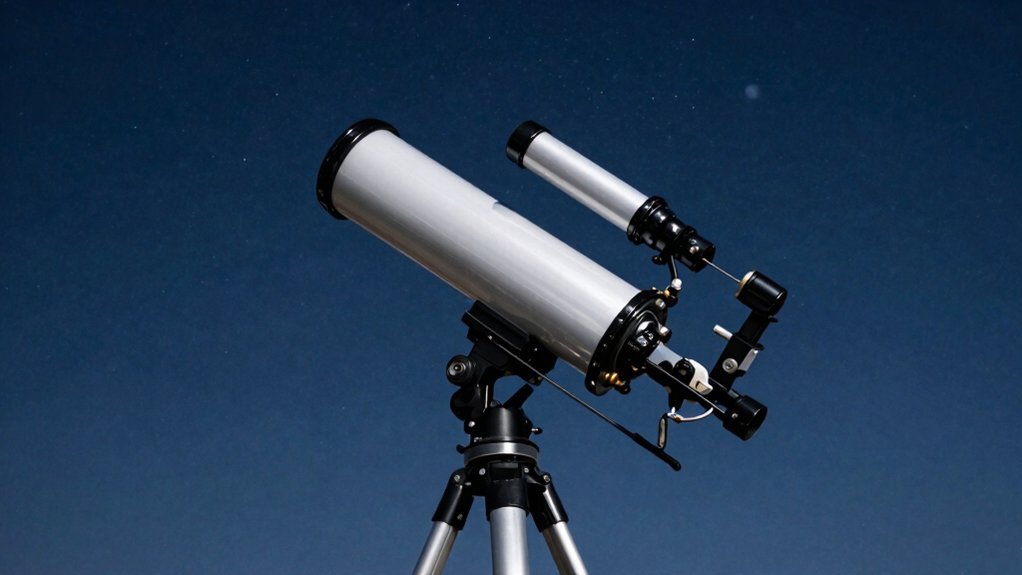
Now, consider the optical performance you actually get from this unique setup. The aplanatic Gregorian design delivers sharp images across a 15-arcminute field without annoying vignetting. You see about 0.1-arcsecond quality over a wide, flat area perfect for research.
All right, let’s talk about where you point this beast in the sky. An altitude-azimuth mount with a derotator keeps your targets steady during long exposures. You capture clear optical and infrared data from high atop Mount Graham’s peak.
These specs make the VATT a powerful research tool, not just a tourist attraction. While professional instruments like the VATT require specific conditions, beginners can still enjoy the sky by understanding observing conditions to maximize their own viewing experience. Just as professional astronomers seek dark sky locations to reduce light pollution, hobbyists should prioritize finding areas with minimal artificial glow for the best results. Ready to uncover what scientists actually find with this incredible instrument?
Primary Scientific Research Goals of the Vatican Observatory
Though the specs you just read are impressive, they’re just the engine for the real work you’re curious about. You want to know what scientists actually study up there on that mountain. They dive deep into planetary research, analyzing asteroids and comets to understand our solar system’s history.
Now, look at the stars. The team examines stellar interactions within binary systems to refine models of how stars live and die. They also track galaxy evolution and probe the universe’s very origins through cosmology. Obviously, this isn’t just idle stargazing; it is rigorous data collection. Enthusiasts should remember that optical clarity is essential for distinguishing fine details in these distant celestial targets.
Here’s the thing: every observation aims to answer fundamental questions about cosmic structure and time. You see a clear commitment to good science alongside faith. This diverse agenda drives their nightly operations forward. Modern instruments utilize advanced spectroscopic analysis to determine the chemical composition of celestial bodies with high precision. Next, you probably wonder who actually runs this complex machine day-to-day. Understanding how light gathering power functions allows these researchers to detect faint celestial objects that would otherwise remain invisible to the human eye.
Who Operates the Telescope on Mount Graham?
So, who actually runs this high-tech eye in the sky? You might assume priests in Rome control everything directly, but that’s not quite right. The Vatican Observatory Research Group manages daily Vatican telescope operations from Arizona, not the Vatican City itself.
They partner closely with the University of Arizona to maintain the Mount Graham infrastructure. This collaboration lets Jesuit astronomers use the 1.8-meter mirror for deep space research. Since 2024, you can even operate the system remotely thanks to new automation upgrades.
Obviously, sharing a mountain with other telescopes requires careful coordination among different scientific teams. You’ll find the real action happens right here in southeastern Arizona at 10,425 feet. Now you know exactly which group keeps the lenses focused on the stars. Ready to learn what specific tools they actually use up there? Understanding the optical design of such instruments is crucial for appreciating how they capture light from distant galaxies. For beginners, knowing that the aperture size determines how much light a telescope can gather helps explain why this large mirror is so effective for viewing faint objects.
Understanding the Real LUCI Instrument on the LBT
You might wonder if the Vatican actually runs a telescope named “Lucifer,” but that rumor mixes up two very different things on Mount Graham. LUCI isn’t a telescope at all; it’s a powerful instrument attached to the Large Binocular Telescope. You see, scientists renamed it from LUCIFER to avoid biblical confusion while keeping its technical purpose clear.
Now, let’s look at LUCI functionality. This device acts like a super-sensitive camera and spectrograph working in near-infrared light. It splits light from distant galaxies so researchers can study their composition and motion precisely. Obviously, visible light misses too much cosmic detail for these specific extragalactic studies.
Consider LUCI applications next. Astronomers use twin units, LUCI1 and LUCI2, to capture data invisible to standard optical telescopes. The Vatican Observatory operates the separate VATT nearby, holding zero authority over this German-Italian equipment. Remember, location caused the mix-up, not ownership or operational ties between these distinct projects.
Major Differences Between the VATT and LUCI
Since you’re mixing up the Vatican’s actual telescope with that fancy instrument nearby, let’s clear the air right now. VATT stands alone as a complete 1.8-meter Gregorian telescope on Mount Graham. You use it for optical and infrared sky surveys since 1993.
LUCI functions differently because it is merely an instrument, not a whole telescope. It plugs into the massive Large Binocular Telescope next door to analyze near-infrared light. You cannot point LUCI anywhere without the LBT’s huge mirrors guiding it.
VATT capabilities include independent operations for targeted follow-ups across multiple wavelengths. LUCI functions specialize in detailed spectroscopy of distant galaxies using another scope’s power. Obviously, one is the camera while the other is the entire tripod.
You now see they serve distinct roles within the same observatory complex. Keep this structural difference in mind as we explore why rumors persist.
Why the “Lucifer Telescope” Rumor Persists Today
Now that you see VATT and LUCI aren’t the same thing, let’s tackle why people still mix them up. You probably wonder how this myth origins story keeps spreading despite clear facts. The original acronym LUCIFER sounded provocative, making it perfect for sensational online posts.
Here’s the thing: rumor dynamics drive these claims because “Lucifer” grabs attention instantly. You see blogs repeating the error that the Vatican owns this instrument. Actually, LUCI sits on the Large Binocular Telescope, not a Vatican device. The Arizona location overlap fuels your confusion about who owns what.
Obviously, repetition across social media keeps this false claim alive today. You encounter videos blurring the line between the telescope and its instrument. Fact-checks consistently prove the Church never operated the nicknamed device.
The takeaway? Location proximity and a catchy name sustain this persistent error. Next, you should verify sources before sharing such wild claims.