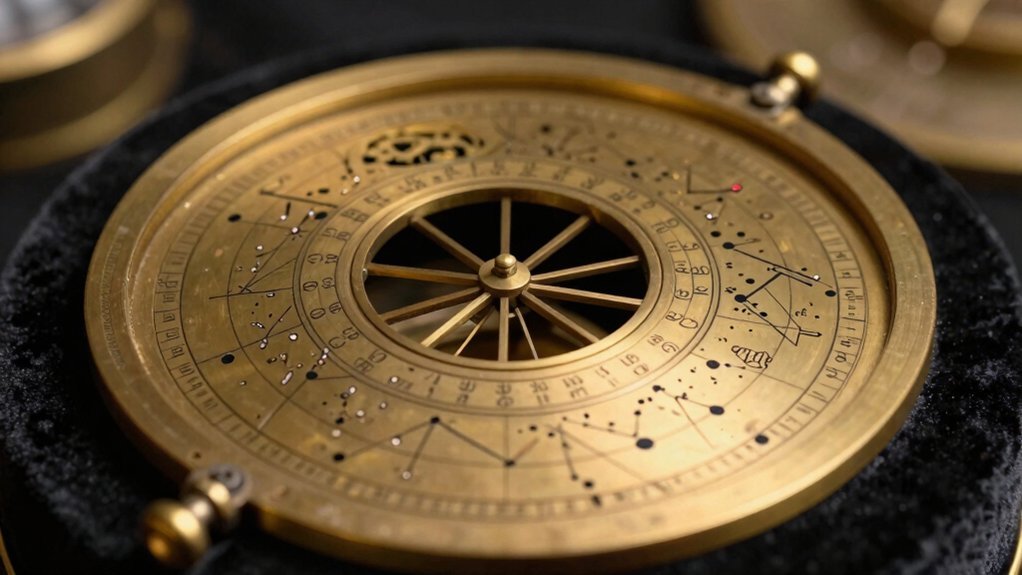
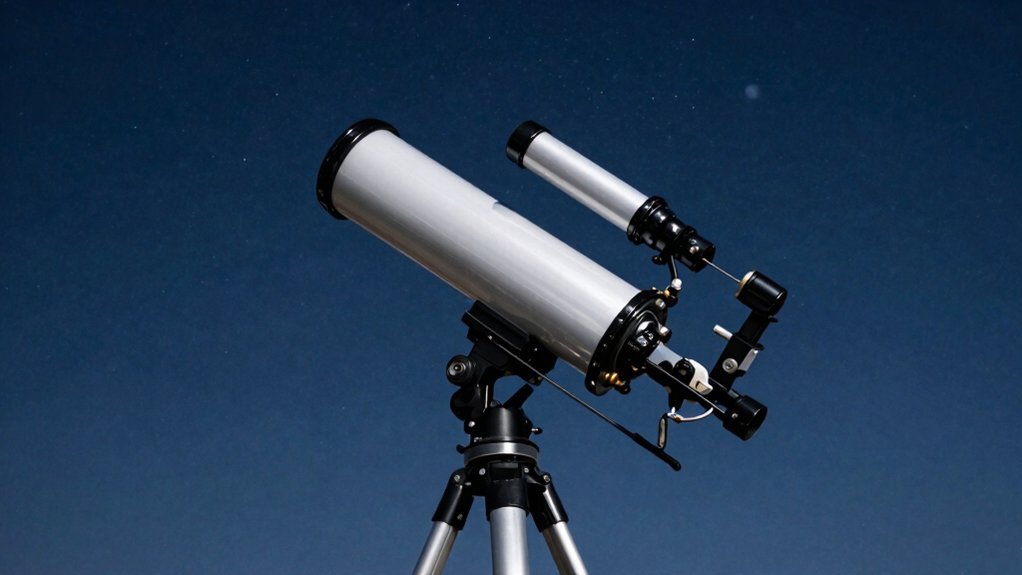
You’re wondering which scopes truly count as optical instruments, and that’s a smart question. Basically, any telescope gathering visible light via lenses or mirrors fits the bill. You’ll find refractors using glass, reflectors bouncing light off mirrors, and hybrids mixing both. Even your binoculars and filtered solar scopes fall into this category. Now, let’s break down exactly how each design shapes what you’ll see in the night sky.
What Defines an Optical Telescope and How Does It Work?
You’re probably wondering what actually makes an optical telescope tick. It gathers visible light to boost brightness and angular size. You see distant stars clearly because these instruments concentrate photons effectively.
Now, consider how curved lenses or mirrors direct rays to a focus. Your optical systems must align perfectly to guarantee sharp pictures every time. Poor alignment ruins image clarity instantly, so precision matters most here.
Here’s the thing: parallel rays from space hit your primary element first. That element bends or reflects light toward a single focal point. You then view this concentrated beam through an eyepiece or camera sensor.
Obviously, different designs like reflectors or refractors handle light uniquely. Yet they all share that core goal of forming usable images. You get better views when the system minimizes errors in the path. Expert-backed guidance suggests that maintaining optical alignment is critical for preventing image degradation in any telescope design.
Understanding the specific light gathering capacity of your chosen instrument is essential for making smart choices that match your observational goals. Even under ideal conditions, the night sky reveals different wonders depending on your location and the time of year.
How Do Refracting Optical Telescopes Use Lenses to Focus Light?
Lenses are your key to accessing distant stars without mirrors. You might wonder how glass actually bends light to show you clear details. Here’s the thing: your telescope’s lens design relies on refraction to focus incoming rays.
The large objective lens grabs light and converges it toward a specific focal point. This action creates a real image inside the tube before your eye sees it. Obviously, this initial image formation is often inverted but incredibly bright and sharp.
Your eyepiece then magnifies that focused spot so you can inspect distant worlds. It re-aligns the light paths, turning the real image into a virtual one you perceive. You get clearer views because the convex glass collects far more light than your pupil alone. Unlike other designs, this setup ensures that refracting telescopes avoid central obstructions that can reduce image contrast. Proper maintenance of these optical surfaces is essential for preserving image quality over time. Enthusiasts should regularly check their equipment for chromatic aberration to ensure the sharpest possible views of celestial objects.
Why Do Reflecting Optical Telescopes Rely on Mirrors Instead?
Someone probably told you mirrors beat lenses, but you’re wondering why astronomers made that switch. You need real reasons, not just opinions. Here’s the thing: mirrors avoid heavy glass blocks entirely.
Large mirrors stay thinner and lighter than huge lenses ever could. This structural freedom lets you build massive apertures easily. Obviously, bigger openings gather far more light for faint deep-sky objects. These mirror advantages solve major weight issues for observatories.
Mirrors also boost optical efficiency by reflecting all wavelengths equally well. Lenses often struggle with color fringing or internal absorption losses. You get sharper images without thick glass slowing photons down. Fabrication costs drop since only one surface needs perfect polishing.
Reflectors dominate professional astronomy because they scale up so practically. You simply cannot make giant lenses this big or cheap. Now you see why reflection beats refraction for serious work. While reflectors excel in size and cost, choosing the right instrument ultimately depends on matching optics and performance to your specific stargazing goals. Different telescope designs offer unique benefits regarding cost and portability for various user needs. Understanding these telescope options helps ensure you select the ideal setup for your viewing habits. Ready to explore how hybrids combine both approaches next?
What Makes Catadioptric Optical Telescopes a Hybrid Design?
Confusion about hybrid optics makes sense when you’ve only seen pure lenses or mirrors. You expect telescopes to pick one path, but catadioptric systems boldly combine both refraction and reflection. They blend glass correctors with curved mirrors into a single, synergistic optical architecture.
Now, consider why this matters for your viewing experience. This unique mix directly tackles stubborn optical aberrations that plague single-element designs. You get sharp images because the lens fixes errors the mirror creates. That’s where real catadioptric advantages shine: compact tubes delivering huge apertures without heavy weight.
Think of it as folding a long light path into a portable package. Schmidt-Cassegrain models prove this works beautifully for high-magnification astronomy. You gain professional-grade performance in a size you can actually carry outside. Obviously, this hybrid approach solves the bulkiness problem inherent in other telescope types. To maximize these benefits, experts recommend allowing your instrument time for thermal equilibrium before beginning your observation session. Understanding how the optical tube assembly functions helps users appreciate the precise alignment required to maintain image quality in these complex systems. This design specifically utilizes a corrector plate at the front of the telescope to eliminate spherical aberration before light reaches the primary mirror.
How Do the Three Main Optical Telescope Types Compare?
How exactly do these three telescope families stack up against each other? You need to weigh specific comparison factors before choosing. Refractors deliver sharp, high-contrast views but suffer from color fringing. Reflectors gather massive light for deep skies yet demand frequent mirror alignment. Catadioptrics blend both designs, offering compact tubes and versatile optical performance. Obviously, your target dictates the best tool for your night sky observing. Large lenses get expensive fast, while mirrors scale easily for bigger apertures. Here’s the thing: refractors stay low-maintenance, whereas reflectors need more hands-on care. Compact catadioptrics travel well but often cost more per inch of aperture. You balance image quality, size, and budget when picking your main scope. Ultimately, no single design wins every category for every stargazer out there. Consider what you value most before committing to one optical path. Understanding optical resolution is also critical, as it determines the finest detail each design can reveal based on its aperture size. Proper collimation alignment ensures that reflectors and catadioptrics maintain their theoretical performance limits during actual observation. Selecting the right aperture size directly influences how much light your telescope can gather to reveal faint celestial objects. Next, you might wonder about binoculars or solar scopes fitting this group.
Are Binoculars and Solar Scopes Considered Optical Telescopes?
Wondering exactly where binoculars and solar scopes fit in the optical telescope family? You’ve asked the perfect question. Binoculars are simply two small refracting telescopes mounted side by side. They use lenses and prisms to gather visible light just like standard scopes. This makes them true optical instruments for your sky watching adventures.
Now, consider solar viewing equipment. A solar scope counts as an optical telescope if it uses lenses or mirrors. It forms a visible-light image of the Sun using specific optical elements. The “solar” label describes your target, not a different physical class of device. Solar filters are essential here to block harmful radiation while allowing visible light to pass through safely for observation. Proper filtration ensures that the intense energy of the sun does not damage the internal optics or the observer’s eyes.
You can definitely enjoy binocular astronomy with these dual-telescope systems. They offer a unique stereoscopic view that single tubes cannot match. Obviously, both tools rely on gathering and focusing light for your eyes. So yes, they belong firmly within the optical telescope category. Keep this classification in mind as you explore further options. Understanding optical design principles helps clarify why these diverse instruments share the same fundamental category despite their different applications.
Which Optical Telescope Design Fits Your Observing Needs?
Since you’re weighing options, let’s match your specific sky-watching goals to the right optical design. You likely wonder which scope truly fits your unique observing target preferences without wasting money.
Refractors use lenses for sharp planetary views, while Newtonians offer huge apertures for faint deep-sky objects. Catadioptrics blend mirrors and corrector plates for portable, all-around performance in a compact tube.
Your choice depends heavily on optical telescope materials like glass lenses versus aluminum mirrors. Obviously, lunar observers need high contrast, whereas galaxy hunters prioritize light-gathering power above all else.
Now, consider how much weight you’ll carry to your dark sky site tonight. Dobsonians provide immense value but lack portability compared to sleek Schmidt-Cassegrain models. For those prioritizing ease of transport, tube length becomes a critical factor when comparing these different optical configurations.
Select the design aligning with your primary interests rather than chasing maximum specs blindly. Which celestial objects excite you most when you look up at night? Understanding optical aberrations helps prevent purchasing a system that compromises image quality for your specific viewing targets.